Key Takeaways
- Ask how many hours you’ll spend in the lab, because shop practice is where you build the skills employers test.
- Construction employers must provide PPE that properly fits each worker, so ask a school what gear it provides and in which sizes.
- Schools that receive federal funding must name a Title IX coordinator, so you can find out before enrolling exactly who handles a harassment report.
TWS is a Great Training Option for Everyone
Learn more about how we can prepare you to advance your career.
Trade schools for women exist, but you don’t need one to train for a skilled trade. Women can enroll in any trade school program or apprenticeship they choose, and the training is the same because welders, electricians, and HVAC technicians use the same skills on the job. What sets one program apart from another is how well it fits you, and a campus tour is where you find out.
Women in trades already work in every one of these fields, and their numbers are climbing. Women’s share of active construction apprentices rose from 4.9% in 2024 to 5.3% in 2025, about 5% of welders are women, and women held 3.5% of electrician jobs in 2025. If you’re planning to join them, the right questions on a tour help you choose a program that fits how you learn, what you need in the shop, and where you want your career to go.
How Much Hands-On Lab Time Will You Get?
Lab time depends on the program, and it’s worth asking about because shop hours are where you practice until a skill holds up under pressure. Some employers test applicants’ skills before hiring, which is why Tulsa Welding School (TWS) career services include employer weld test prep and on-campus recruitment testing.
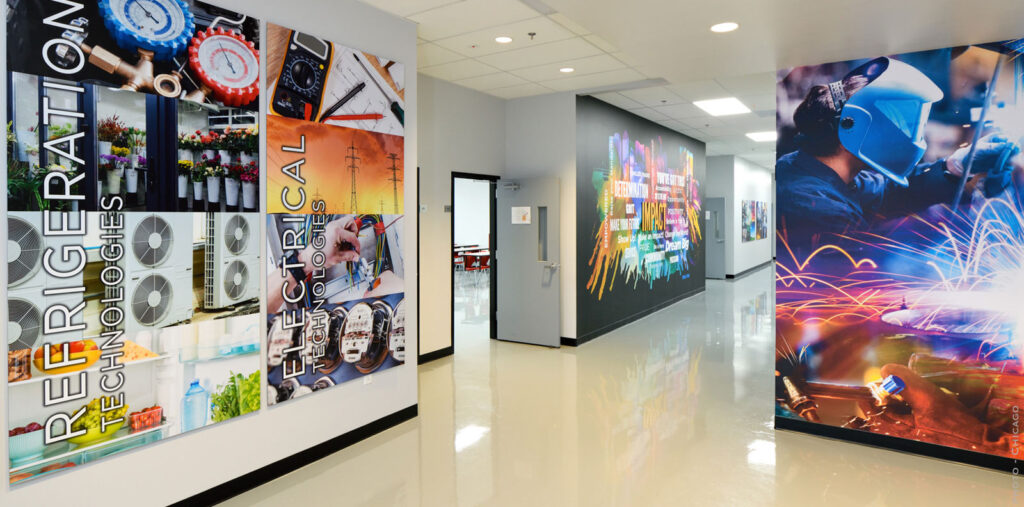
At TWS, Professional Welder Training includes 100 lab hours and 25 lecture hours in each of its six courses. Theory is taught online, so your time on campus goes to hands-on work. In Electrical Technologies, you’d wire a scaled-down three-bedroom home and a mock commercial building using conduit.
Have You Considered a Career in the Skilled Trades?
Fill out the form to recieve a no obligation info packet.
A course list only tells you so much.
Ask to see the workshops while classes are running, so you can check whether the training equipment matches what industry uses and how much time students spend with tools in hand. If the school allows it, sit in on a class.
The answers to these questions tell you how much practice you’ll get and whether you’ll spend lab time waiting for equipment:
- How many lab hours does each course include, compared with lecture hours?
- How many students share a welding booth or work station?
- Can I watch a lab session in progress?
Does the School Provide PPE That Fits Women?
It depends on the school, so ask what safety gear the program includes and which sizes it comes in. Gear that fits is gear that protects you, and since Jan. 13, 2025, construction employers must select PPE that properly fits each employee. The rule notes that standard-size PPE doesn’t always fit varying body shapes, which can affect smaller workers, including some women.
Fit affects safety as much as comfort. Nearly three-quarters of tradeswomen have faced unnecessary hazards from PPE that doesn’t fit. Gear sized for women is easier to find than it used to be, as PPE and tool makers have expanded their fit ranges.

New: Industrial Maintenance
Learn About Our New Advanced Industrial Maintenance Program
Tulsa Welding School is proud to announce our newest program offering available at our Houston & Dallas Metro Campuses – Advanced Industrial Maintenance Technology! Learn the skills you need to take on the industries of manufacturing, distribution, energy production and facility maintenance in as few as 7 months.
At TWS, welding students receive a gear package, and Electrical Technologies’ Residential Wiring course covers electrical safety and PPE.
Asking about gear up front tells you what you’ll need to buy on your own and whether you’ll train in gear that fits from the first day:
- What’s in the gear package, and does it come in women’s sizes?
- Can I exchange gloves, jackets, or boots that don’t fit?
- Can I bring my own gear if it meets the shop’s safety rules?
What Should the Shop and Campus Facilities Include?
Look for the same equipment you’ll use on the job, along with restrooms and changing areas you can reach quickly during a long lab session. Job sites set a useful standard. Employers must provide toilet rooms separate for each sex and prompt access to them when needed, and a school shop that meets the same standard shows the school planned for every student.
If you’d take evening or overnight classes, campus safety after dark matters too. Some TWS welding schedules run from midnight to 5:15 a.m., so ask about lighting, parking, and building access. A virtual tour lets you preview a campus’s labs before you visit in person.
These questions show you what a normal day in the shop looks like, from where you’ll change to how you’ll get to your car after class:
- Where are the restrooms and locker or changing areas compared with the shop?
- Which equipment brands and processes will I train on?
- How is the building secured during evening and overnight classes?
Can You Meet Women in Trades Who Teach or Graduated from the Program?
Yes, you can ask to meet women instructors, current students, or graduates during a tour or afterward. They can answer the questions a brochure can’t, like how instructors run the shop, how classmates work together, and whether the gear fit. A graduate can also tell you how the training held up once she started working.
Connections outside school help women in trades too. The American Welding Society Foundation offers a Women in Welding scholarship, so ask whether a school helps students find scholarships like it.
Talking with women who’ve been through the program gives you a firsthand read on daily life in the shop that a tour guide can’t always give:
- How many women teach in my program, and can I meet one?
- Can I talk with a woman who’s enrolled now or who graduated recently?
- Does the school connect students with tradeswomen’s groups or mentors?
How Does the School Handle Harassment?
Every school that receives federal funding must have a process for handling harassment, so ask to see it and find out who runs it. Title IX is the federal law that bars sex discrimination in education programs that receive federal funding, and those schools must designate a coordinator and publish grievance procedures. Schools must also tell students the coordinator’s name or title, office address, email address, and phone number.
Knowing the process ahead of time matters because harassment does happen in the trades. In a 2021 survey of more than 2,600 tradeswomen, nearly 1 in 4 reported near-constant sexual harassment. A clear school process gives you a way to act quickly if something goes wrong, and how a school explains it shows you how seriously it takes the issue.
At TWS, each campus’s director of education serves as its designated Title IX coordinator, and any person may report at any time. TWS’s Title IX Policy took effect Oct. 1, 2026. It offers supportive measures and prohibits retaliation, and it sets a formal process to be completed within 120 days of filing. Informal resolution isn’t available when an employee is accused of sexually harassing a student.
Asking these questions before you enroll means you’ll already know where to go and what happens next if you ever need to report something:
- Who is the Title IX coordinator here, and how do I reach them?
- What supportive measures can I get while a report is reviewed?
- What happens if the complaint involves an instructor?
Can the Class Schedule Fit Your Life?
A program only works if you can show up for it, so ask for exact class times and how much flexibility the school offers. At TWS, the welding program offers morning, afternoon, evening, and overnight classes at some campuses, along with a weekend and evening track.
| Shift | Class times |
|---|---|
| Morning | 7:30 a.m. to 12:30 p.m. |
| Afternoon | 1 to 6 p.m. |
| Evening | 6:30 to 11:30 p.m. |
| Overnight | Midnight to 5:15 a.m. |
| Weekend and evening track | Tuesday and Thursday, 6:30 to 9 p.m., with Saturday and Sunday labs from 8 a.m. to 6 p.m. |
TWS programs use a hybrid model, with theory online and labs on campus, so you can fit coursework around work or family time. TWS’s flexible class schedules help students who are also parents.
Your schedule may change during a seven-month program, and these questions show whether the school can change with it:
- Can I switch shifts if my work or childcare schedule changes?
- What happens if I miss a lab day?
- How long does the program take on an evening or weekend schedule?
What Will Career Services Do for You Before and After Graduation?
Career services can help you land your first job, so ask what the team does in practice and how long you can use it. At TWS, career services helps students and graduates with:
- Resume writing
- Job searches
- Interview prep
- Employer weld test prep
- On-campus recruitment testing
Graduates in good standing can return to brush up on skills, and the Career Connect job board is available to all alumni. TWS can’t guarantee employment, so ask how recent graduates have done.
You don’t have to take a school’s word for it. Schools must give students information on where graduates find jobs, which can come from state data, alumni surveys, or the school’s own published placement rate. Completion rates must be public by July 1 each year, and if you ask, the school must give them to you before you enroll or take on any financial obligation. Federal tools also let you compare schools side by side and check graduation rates and earnings.
These questions help you picture life after graduation and check whether the program’s track record matches what you hear on the tour:
- Which employers recruit on campus?
- What do graduates’ completion and job placement numbers look like?
- Can I use career services years after I graduate?
Which Documents Should You Request Before You Enroll?
Request the course list, gear package list, Title IX policy, annual security report, consumer information sheet, and class schedule before you enroll, because each one puts an answer from your tour in writing. Comparing them across programs lets you judge trade schools for women on more than a first impression. Schools must also distribute their annual security report to enrolled students by Oct. 1 each year.
Each document answers a different question from your tour:
| Document | What it shows | Where to find it at TWS |
|---|---|---|
| Course list with lab and lecture hours | How much class time is hands-on | Program pages, such as Professional Welder Training |
| Gear package list | Which PPE is included and in what sizes | Admissions representative |
| Title IX policy | How reports are filed, investigated, and resolved | Title IX information page |
| Annual security report | Campus crime and safety information | Regulatory information page |
| Consumer information (Right-to-Know) sheet | How completion and employment rates are calculated | Regulatory information page |
| Class schedule | Shift times, weekend options, and start dates | Program pages |
Bring Your Questions to a Campus Tour
When you compare trade schools for women, look for a program that answers these questions with specifics and backs them up in writing. Schedule a campus tour and bring these questions, or request more information about programs, schedules, and gear.