Associate of Occupational Studies in Mechanical Maintenance Engineering
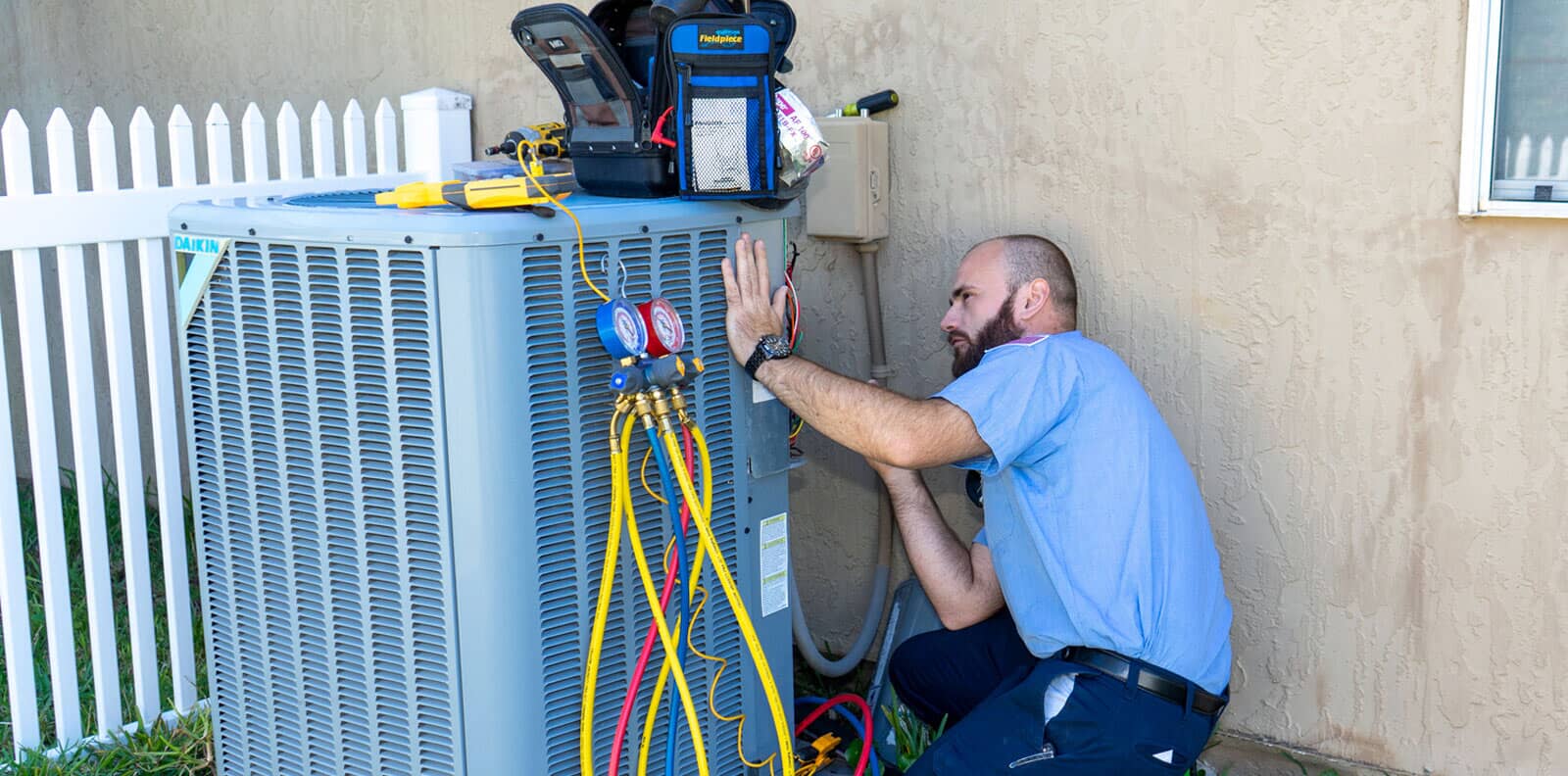
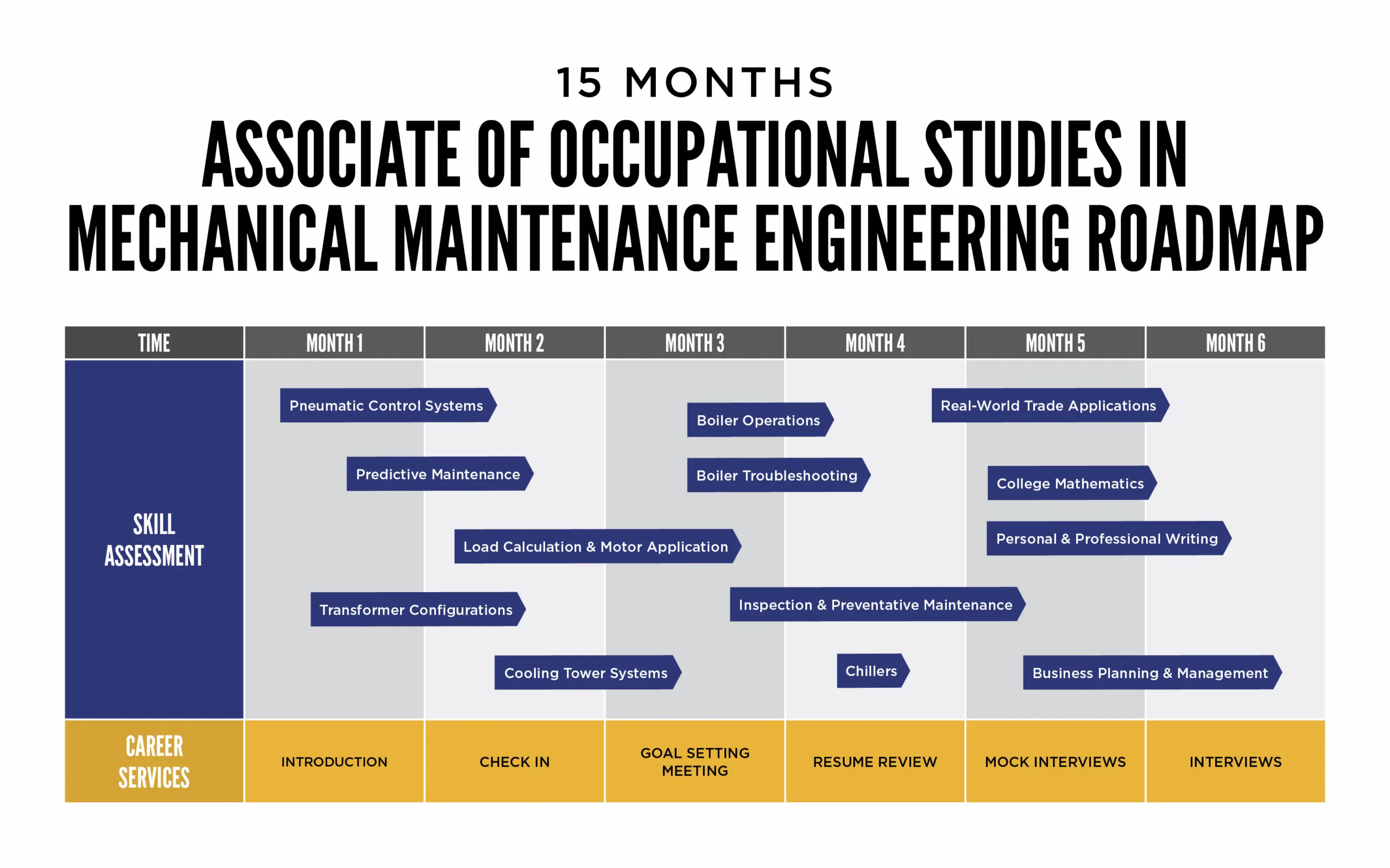
Start training for a new career in less than 15 months with an Associate of Occupational Studies in Mechanical Maintenance Engineering! Open to door to additional career opportunities in the HVAC/R industry.
Request More Info
It's easy - just fill out the form below and get ready for your exciting journey into training for a new career.
Upcoming Start Dates
Oct. 25, 2026 & Dec. 6, 2026
Duration: 15 months
15 months of hands-on training and real-world skills.
Campus Availability
START TRAINING FOR YOUR HVAC/R CAREER TODAY
TWS’s 15 month Associate of Occupational Studies in Mechanical Maintenance Engineering Degree program includes the completion of the on-campus Electro-Mechanical Technologies program.
The remaining coursework for the Associate of Occupational Studies in Mechanical Maintenance Engineering Program is available online or on-campus.
What can you do in 15 months?
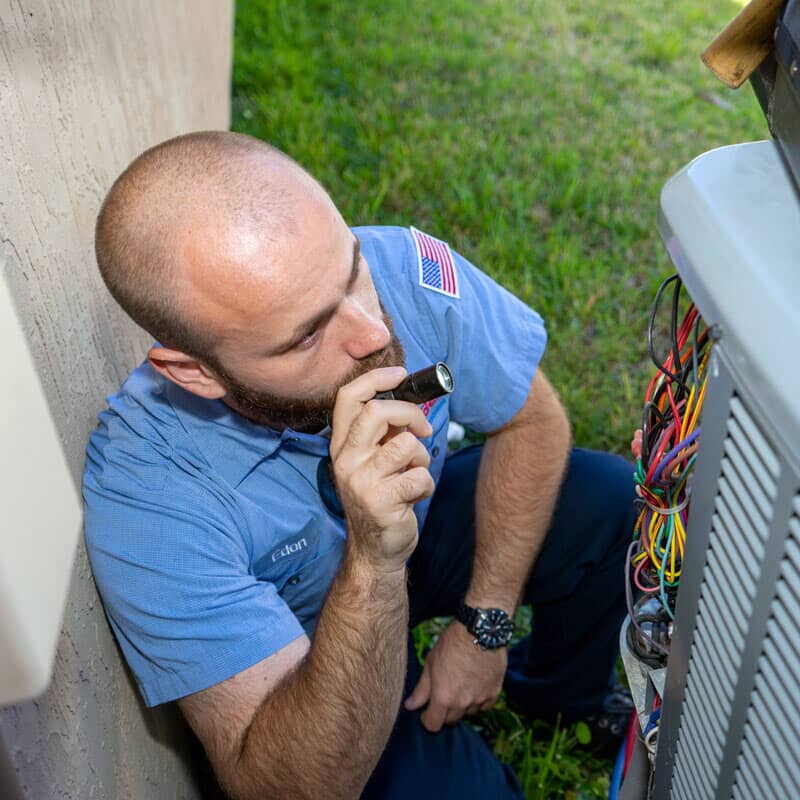
Mechanical maintenance engineering covers a broad range of potential employment options in heating, ventilation, air conditioning and refrigeration (HVAC/R). Graduates of this program would be great candidates for entry-level jobs that require maintaining and servicing large, complex systems in the HVAC/R industry. Some career options are:
- Facilities Maintenance
- Engineer/Technician
- HVAC/R Service Technician
- HVAC/R Installation Technician
- Refrigeration Service Technician
- Refrigeration Installation Technician
- Low-Temperature Field Technician
- Restaurant & Retail Refrigeration Technician
- Commercial Refrigeration Technician
- Power Plant Field Technician
- Maintenance Electrician
- Boiler Operator
Employment is Expected to Grow for HVAC/R in the US by 42,500 Jobs by 2033!5

Frequently Asked Questions
The Associate of Occupational Studies in Mechanical Maintenance Engineering at TWS is a 15-month program that combines hands-on and academic training. Students complete the on-campus Electro-Mechanical Technologies program as part of their studies, while the remaining coursework can be completed either online or on-campus. This program prepares students with the technical skills and knowledge needed for careers in mechanical maintenance and engineering.
Learn More about The Associate of Occupational Studies in Mechanical Maintenance Engineering program at TWS!
There are a few steps to getting your Associate of Occupational Studies degree. The steps to job security, higher wage potential1 and management opportunities include:
Step 1. Earn Your High School Diploma or GED
The first step is to complete your secondary education. This will lay a solid foundation for your Mechanical Maintenance Engineering program’s success. This is also a requirement when enrolling at Tulsa Welding School (TWS).
Direct Path:
Step 2. Apply for the AOS Program
The AOS program incorporates the EMT prerequisite curriculum, allowing direct enrollment into the full 15 month degree pathway.
OR
EMT First Path:
Step 2. Complete the Electro-Mechanical Technologies Program
The Electro-Mechanical Technologies program can be completed in as little as 9 months. This will help you build a broad knowledge of electrical and mechanical technologies, including HVAC/R.
Step 3. Apply for the AOS Program
After completing the prerequisite courses, you’re eligible to apply for the AOS program.
The completion of AOS MME takes 15 months in total (including prerequisite courses) or in 6 months with EMT pre-requisites completed.
Yes. It is approved by the Accrediting Commission of Career Schools and Colleges (ACCSC) and licensed by the Arizona State Board for Private Postsecondary Education. A benefit of this type of degree is that technical and general education courses are applied to the occupation for which training is intended.
Possible job opportunities include, but not limited to:
- HVAC/R technician
- Power plant field technician
- Commercial Service Technician
- Air Conditioning Technician
- Maintenance Electrician
- HVAC Service Technician
- Refrigeration Service Technician
- Commercial Refrigeration Technician
- Low-Temperature Field Technician
- Restaurant & Retail Refrigeration Technician
Flexible Class Schedules
Morning, afternoon & evening classes available
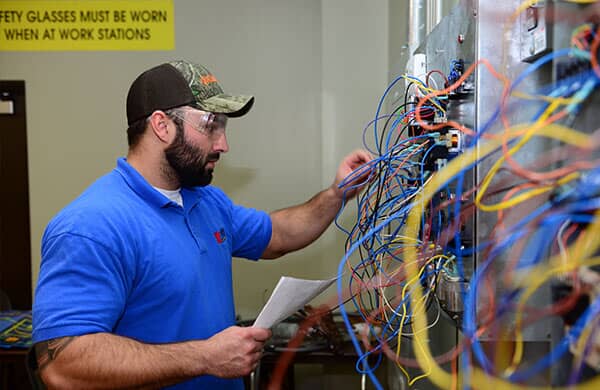
TWS offers flexible schedules whether you are just graduating from high school, changing your career, or transitioning from military to civilian life. We work hard to find the right program and the right schedule to help you succeed. Contact us for more information on upcoming class times and start dates for the AOS in MME program.
Experiences & Opportunities
Resources for TWS Students
Virtual Tour
Take a virtual tour of our campuses! Explore the classrooms, labs and shop floor with our unique interactive experience.
Employer Relationships
TWS has relationships with major employers across the United States. Our dedicated Career Services team will be there to support you every step of the way after graduation.
The Right Tools for the Job
When you begin your education at TWS, we provide you with an extensive gear package. You get the high quality professional tools you need to succeed. Ask your Admissions Representative for more information about the gear package for your program.
Scholarship Opportunities
Learn more about what scholarship opportunities are available and how you might qualify for one. Start the process of applying for a scholarship today!


Jumpstart Your Skilled Trades Career with TWS Scholarships
Empower your journey toward a rewarding career in Skilled Trades. Tulsa Welding School offers a diverse portfolio of scholarships — both TWS-provided and external — tailored to help you succeed.
Explore, apply early, and let Tulsa Welding School’s advisors help guide your financial-aid journey.
Class Start Dates and Scheduling
Campus Start Dates
Location
Date
Phoenix, AZ
Oct. 25, 2026 & Dec. 6, 2026
Class Schedule Options
Students may choose from any of the following flexible options
Hybrid HVAC Training That Fits Your Life
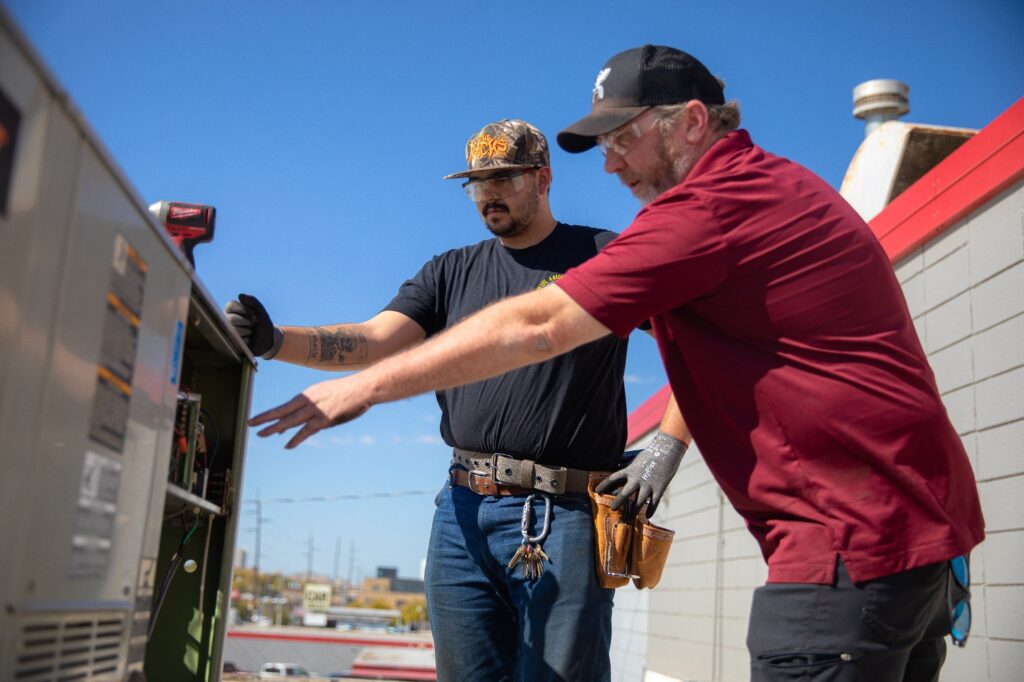
At TWS, we know you’re here to build real-world skills, not spend endless hours in a classroom. That’s why we offer a flexible online hybrid model, allowing you to complete the theoretical parts of your program online, as long as it’s done by the deadline. When you’re on campus, your time is spent where it counts: hands-on in the lab with tools, equipment, and expert instructors.
This approach gives you the freedom to balance school with other responsibilities, while still getting the hands-on training you need for a successful career in the skilled trades.
Ready to Move Forward?
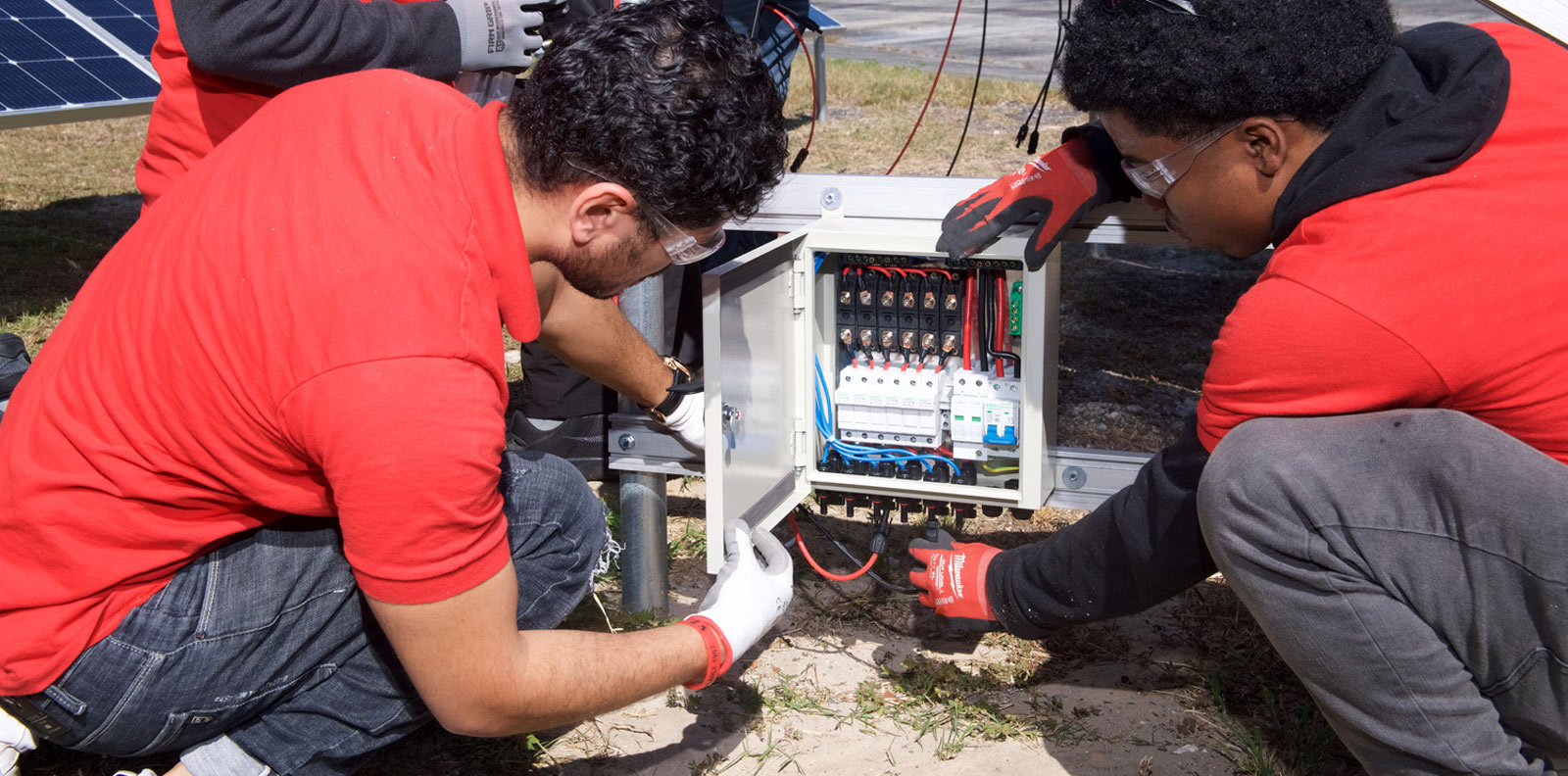
All it takes to move forward is making that first step. Whether you need more information, schedule a tour or want to speak to someone, we’re with you every step of the way.
Are YOU ready to change your life?
Listen to these TWS graduates who changed theirs.
We all come from different walks of life, and different circumstances, but it’s the hard work we do and the blood sweat and tears put in to make us who we are today.
Tulsa Welding School gave these graduates the structure, confidence, and guidance they needed to make a difference in their lives. It only takes one decision to start the journey on a path towards a better career. A better Life.
Hear the stories of these TWS graduates and how they changed their lives:
Geicil - Welding Graduate
After moving to the U.S. from the Philippines and starting a family, Geicil knew it was time to pursue a career that could provide the future they all deserved. When her husband told her about Tulsa Welding School, she took the leap. She graduated in just seven months and landed a welding job shortly after graduation. Today, she’s a high-frequency TIG welder doing work for the U.S. Navy, a mission close to her heart with her stepson serving. She’s proud of how far she’s come and hopes her story inspires others to work hard and aim high. Hear her story on how TWS changed her life.
Michael - HVAC/R Graduate
Growing up in 1980s–90s Los Angeles, Michael faced the daily pressures of gangs and drugs. After asking himself, “Would my father be proud of the man I am today?” he realized it was time for change. While working in a warehouse, a chance moment with an HVAC technician sparked a new path, and he enrolled at Tulsa Welding School. After graduating and working as an HVAC/R tech, Michael earned his contractor’s license and eventually launched his own business. Today, Michael enjoys traveling with his son to BMX competitions and living life on his own terms. He calls TWS the launchpad for the incredible journey he’s on now. Hear his story on how TWS changed his life.
Kathryn - Electrical Graduate
As a single mother, Kathryn knew finding a work/life balance wouldn’t be easy, but she refused to settle. Despite skepticism from others, Kathryn enrolled at Tulsa Welding School to pivot away from another career that wasn’t fulfilling. The flexible schedule made it possible, and before even graduating, she landed a job offer. Today, she’s thriving in a role where she feels valued and finally has the balance to be fully present for her daughter. Kathryn credits TWS for helping her reclaim her future on her own terms. Hear her story on how TWS changed her life.
Program Courses for Associate of Occupational Studies in Mechanical Maintenance Engineering
Prerequisite Courses
This program requires completion of the Electro-Mechanical Technologies program prior to enrolling.
Click here for the Electro-Mechanical Technologies class descriptions.
Sound Interesting? Contact us for more information on this course and the Electro-Mechanical Technologies program below.
Basic College Mathematics
BCM100
This course presents the fundamental concepts of a pre-algebra course.
Students will be introduced to whole numbers, fractions and decimals, integers, order of operations, percents, signed numbers, measurements, geometry, probability, and basic algebra concepts.
This course is available via online courses only and is taken in tandem with other courses and does not add weeks to the total program length.
Requirements
- 3 Semester Credit Hours
- 45 Lecture Hours
- 45 Total Contact Hours
- 112 Outside Prep Hours
English Composition
ENG100
This course develops written communication skills with an emphasis on understanding the writing process, analyzing readings, and practicing writing for personal and professional applications.
This course is available via online courses only and is taken in tandem with other courses and does not add weeks to the total program length.
Requirements
- 2 Semester Credit Hours
- 29.5 Lecture Hours
- 29.5 Total Contact Hours
- 100.5 Outside Prep Hours
Principles and Applications of Air
MME205
This course includes the study of typical pneumatic control systems: the evaluation, maintenance, operation and troubleshooting of the air station, controlled devices, controllers, receiver controllers, transmitters, relays, and switches which make up a pneumatic control system. An introduction to air compressors which drive a pneumatic system is also discussed, provided are the mathematic concepts similar to those described in Liquid Piping, as applied to the advanced study of the properties of air and heat calculations with the use of a psychometric chart, along with information, calculations and formulae used in fan operation and analysis, duct work and air distribution, air outlets, air balancing, belt and sheave analysis and air filters.
Prerequisite Course(s): All Lower Division Courses
Requirements
- 2 Semester Credit Hours
- 50 Lecture Hours
- 50 Total Contact Hours
- 12 Outside Prep Hours
Motors and Applications
MME210
This course covers the techniques and calculations (including evaluation of expressions, order of operations, symbols of inclusion and power exponents) to determine load and sizing requirements for heating and cooling equipment. Included is the 24 hour method of load calculation and sizing of residential and commercial air conditioning and heating equipment as well as commercial refrigeration equipment. Additionally, the course covers the application of single and three phase motors. Applications include motor types, operation, components, control hookups, motor feeder and branch circuit conductors, motor protection, motor control circuits and motor connections and testing, connections, transformer schematics and auto transformers of low and high voltage systems.
Prerequisite Course(s): All Lower Division Courses
Requirements
- 2 Semester Credit Hours
- 50 Lecture Hours
- 50 Total Contact Hours
- 12 Outside Prep Hours
Predictive Maintenance and Piping Systems
MME215
This course covers why and how compressors fail, how to detect the cause of compressor failures, and how to prevent repeat compressor failures. Commercial serviceable hermetic reciprocating compressors are covered, as well as Rotary and Scroll compressor operation and servicing. Also covered are maintenance of reciprocating, rotary and centrifugal air compressors and compressed air systems. This course also covers types of distribution systems, materials and accessories found in water refrigeration systems.
Also covered are concepts including evaluation of expressions, order of operations, symbols of inclusion, power exponents, proportions and computation of surface area uses applied to liquid piping operations. Included are: calculations and methods to determine pressure drops and pipe friction in water and refrigeration lines; techniques and methods to calculate the sizes of suction, discharge and liquid line of single and multiple piping systems in HVAC equipment and water lines; and methods and procedures to size water pumps and calculate pump head.
Prerequisite Course(s): All Lower Division Courses
Requirements
- 2 Semester Credit Hours
- 50 Lecture Hours
- 50 Total Contact Hours
- 12 Outside Prep Hours
Transformers and Technical Math
MME220
This course provides students an introduction to transformer concepts and theories used in the building industry and technical mathematics. Topics include: Transformer configurations, cooling, wiring, and order of operations, ratios, exponents, algebraic methods, and solid figures. Students demonstrate their proficiencies via participation, exercises and periodic quizzes and examinations.
Prerequisite Course(s): All Lower Division Courses
Requirements
- 2 Semester Credit Hours
- 50 Lecture Hours
- 50 Total Contact Hours
- 12 Outside Prep Hours
Cooling Towers and Maintenance
MME225
This course covers cooling tower history and theory. Included are waste heat disposal, maintenance and inspection of interior and exterior structure, mechanical equipment including fans, gear boxes, power transmission and motor. Also covered are different types of cooling towers, water distribution systems, upgrading of existing cooling towers, water treatment, and water filtration and purification methods. Also covered is the installation, start-up and troubleshooting of 15-200 ton conventional reciprocating liquid chillers. Included are conventional chiller controls, step controllers used in chiller capacity, electronic controls and operation, microprocessor chiller controls, their operation, troubleshooting, and flotronic chiller operation and troubleshooting.
Prerequisite Course(s): All Lower Division Courses
Requirements
- 2 Semester Credit Hours
- 150 Lecture Hours
- 50 Total Contact Hours
- 12 Outside Prep Hours
Chillers
MME240
This course covers the differences in components and operation between centrifugal and reciprocating chillers. Included is a study of the centrifugal compressor, its operation, components and troubleshooting. The familiarization, operating sequence, start up, troubleshooting application, and operation of the microprocessor expanded service panel are covered. Finally, central station air handling units with Product Integrated Controls (PIC) operation and troubleshooting is covered. In addition this course covers steam and direct fired absorption systems as well as screw compressor systems. Included are system operation, system components, system controls, control sequences, start up, maintenance, troubleshooting and installation procedures for both types of systems. Also covered is an absorption system.
Prerequisite Course(s): All Lower Division Courses
Requirements
- 2 Semester Credit Hours
- 50 Lecture Hours
- 50 Total Contact Hours
- 12 Outside Prep Hours
Fundamentals of Boilers
MME245
This course covers the principles of low pressure boiler operation. Included are boiler operation, fittings, feedwater accessories, steam and combustion controls, draft control and water heating systems. The principles of high pressure boiler operation. Included are steam boiler types, package and field erected boilers, the steam system, feedwater systems, fuel system, feedwater and fuel heaters, pumps, regulators, traps, superheating, desuperheating, and pressure reducing systems and steam boiler operation.
Prerequisite Course(s): All Lower Division Courses
Requirements
- 2 Semester Credit Hours
- 50 Lecture Hours
- 50 Total Contact Hours
- 12 Outside Prep Hours
Boilers and Boiler Systems
MME250
This course covers the techniques and procedures for boiler operation and evaluation. Included are oil fired boiler installation, steam boiler operation, hot water boiler operation and evaluation, boiler start-up, service and troubleshooting, as well as boiler instruments, water treatment and boiler room safety. Also provided are the fundamentals of multiple boiler operation, hydronic systems, the principles of zoning, system sizing and calculations, zone valves, boiler selection, as well as boiler piping, installation and troubleshooting.
Prerequisite Course(s): All Lower Division Courses
Requirements
- 2 Semester Credit Hours
- 50 Lecture Hours
- 50 Total Contact Hours
- 12 Outside Prep Hours
Preventative Maintenance and Planning
MME255
This course covers the techniques and procedures for boiler and chiller inspection and maintenance. Included are preventive and predictive maintenance procedures, maintenance of boiler room and heating equipment, fire protection and structure, and maintenance of centrifugal, reciprocating, OPAC, and modular liquid chillers. Included in this course covers the fundamentals and procedures necessary for starting and running a personal business, including topics on writing successful business plans, licensing requirements and information, different types of business organizations, business assets, and business operation.
Prerequisite Course(s): All Lower Division Courses
Requirements
- 2 Semester Credit Hours
- 50 Lecture Hours
- 50 Total Contact Hours
- 12 Outside Prep Hours
Computer Applications and Decision Making
Phase 214
This course covers the fundamentals, components and operations of computers and computer systems.
Included is an introduction to computer basics, computer components and operations, hardware configuration and software applications. Also covered are a demonstration and application of miscellaneous software relating to the industry. This course emphasizes the concept that service is produced and consumed simultaneously, and addresses communications and active listening methods to ensure this transaction is profitable and positive.
Includes servicing techniques in dealing with customers in a positive manner.
Requirements
- 2 Semester Credit Hours
- 50 Lecture Hours
- 50 Total Contact Hours
- 12 Outside Prep Hours
Entrepreneurship
MME265
In this course, students learn academic theory, review case studies, and complete exercises in critical thinking that help student entrepreneurs start-up a small business and related communication skills with an emphasis on professionalism.
Requirements
- 2 Semester Credit Hours
- 45 Lecture Hours
- 45 Total Contact Hours
- 9 Outside Prep Hours