TWS is a Great Training Option for Everyone
Learn more about how we can prepare you to advance your career.
HVAC could be a promising career for those who don’t want to spend at least four years at a college or work an office from 9 to 5. The job outlook for HVAC technicians is much better than average: the projected job growth rate from 2016 to 2026 is 15%, compared to 7% for all other occupations.[1] Following is a step-by-step guide on how to become an HVAC technician.
What Types of HVAC Training Are Available?
You can take a few different paths to become an HVAC technician, including going directly into an apprenticeship program, enrolling in a degree program or attending a technical school.
Apprenticeship
An apprentice gets on-the-job training by working alongside a mentor with experience in the trade. Apprenticeships may be expected to have a strong grasp of algebra, geometry and blueprint reading.4,5
Community College
Many community colleges also offer HVAC training courses. Four-year bachelor programs are available at universities but are more favorable for those who are interested in the business side of an HVAC career.6
Have You Considered a Career in the Skilled Trades?
Fill out the form to recieve a no obligation info packet.
A two-year associate degree is far more common and more suited to those who want to get to work faster without the additional course requirements of a bachelor’s degree. In addition to coursework in HVAC systems, a two-year program typically requires courses in general education, such as liberal arts and mathematics.6
Trade School
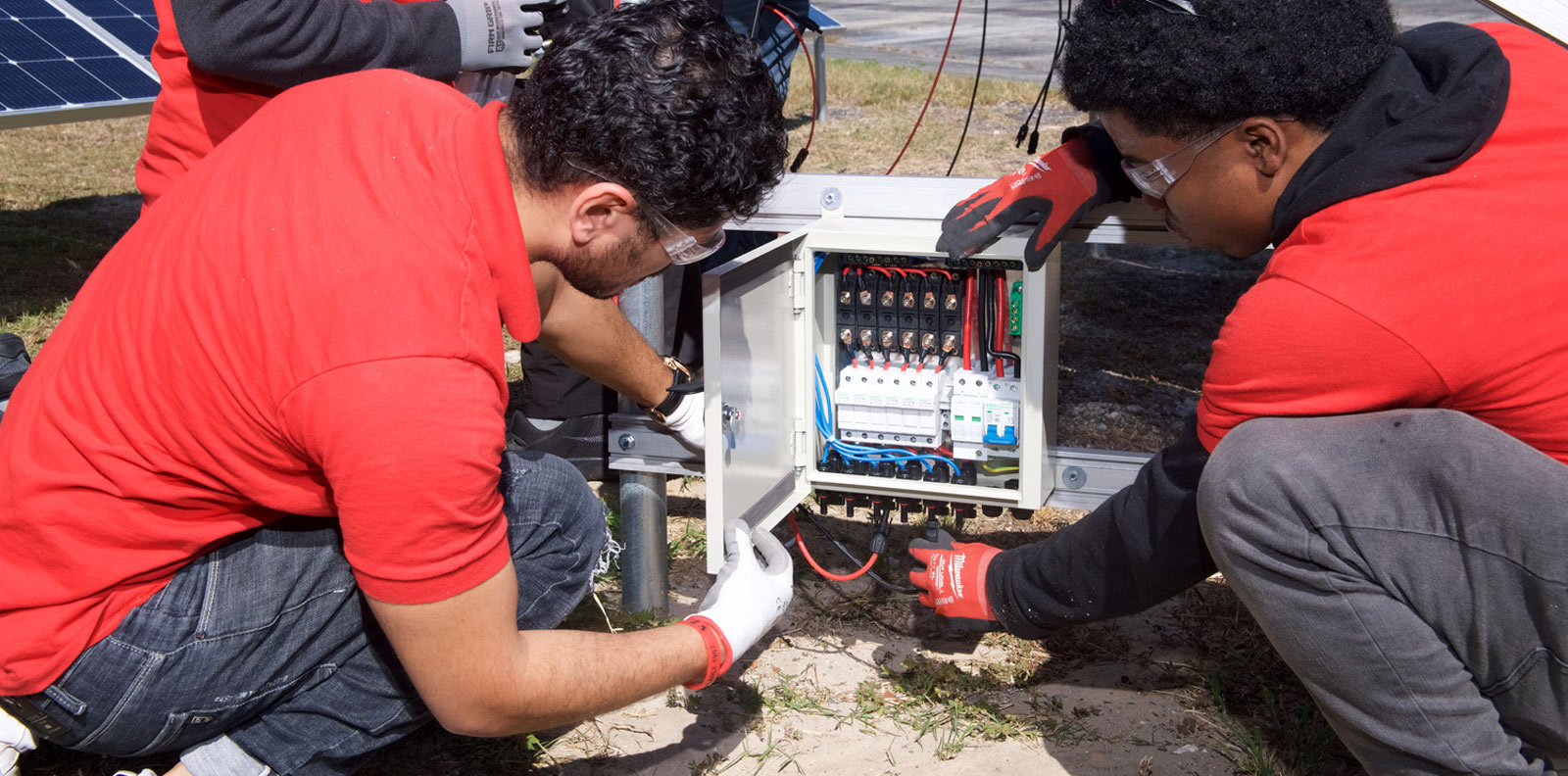
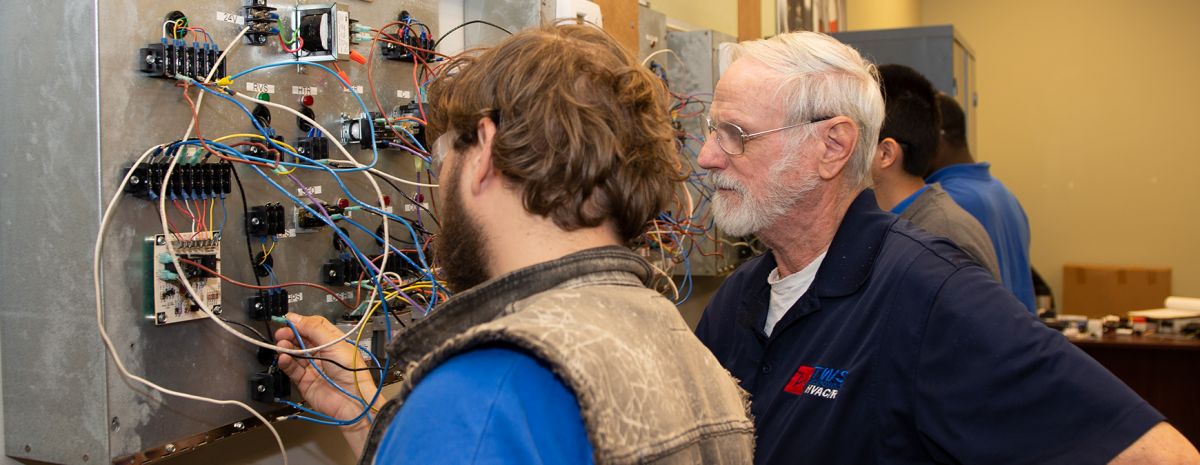
Trade school is another option and perfect for those who want to skip past English composition courses and get right to the hands-on training. The Refrigeration Technologies program at TWS, for examples, offers instruction in:
- Fundamentals of Electricity
- Fundamentals of Refrigeration
- Comfort Systems – Residential
- Comfort Systems – Commercial
- Refrigeration Systems and Practices
- Advanced Troubleshooting
How Long Can Training to Become an HVAC Tech Take?
Apprenticeship
An apprenticeship can be the longest route. Many take up to five years to complete.2
Community College
Most associate degree programs take two years to complete, but some can be completed in 18 months, depending on the program, as well as the degree or certification offered.7 Some programs include general education, such as communications and liberal arts classes.6
Trade Schools
HVAC schools can be the shortest option and can be completed in as little as six months. They’re designed to train students for entry level work as an HVAC tech, and many will prepare students to sit for certification exams, such as those required by the EPA for refrigerant handling.
Step 1: Get a high school diploma/GED
HVAC systems are increasingly complex and require a lot of technical knowledge. For that reason, many aspiring HVAC techs embark on vocational training, for which you will need a high school diploma or GED. If possible, you should take high school courses in vocational education, math, chemistry, and physics. Any knowledge of electrical work, electronics, or plumbing may also help you ease into your HVAC training.
Step 2: Complete HVAC training
Once you obtained your high school diploma or GED, you can apply for vocational HVAC training. Since the trade has become quite multifaceted and reliant upon digital technology, employers typically prefer candidates with formal training. HVAC training at TWS in Houston or Jacksonville can be finished within 7 months. You learn about the fundamentals of electricity, solar, and refrigeration. You also work on residential-, commercial-, and refrigeration systems. You will have the ability to hone HVAC skills like identifying causes of operating errors, performing routine system maintenance, and installing the correct equipment.
Step 3: Obtain EPA license
In the U.S., all technicians who buy, handle, or work with refrigerants must be certified, as mandated by the U.S. Environmental Protection Agency (EPA). The EPA has developed four different types of certification, depending on what equipment you work on.[2] Some states and localities also require additional licensing, so you should always check with the relevant regulating body as to what credentials you will need to be able to work.
Step 4: Network in the industry
Whether you are still enrolled in a training program or have just graduated, networking in the industry is important for getting in touch with employers and staying up-to-date with the latest industry developments. A great opportunity for networking are construction conferences, where professionals from various trades gather and hold panel discussions, workshops, and plenary sessions. Local job fairs are another option for identifying businesses that are on the look out for skilled workers.
Step 5: Find your dream job
Now it is time to “pitch” yourself to potential employers. All the right skills and credentials may not matter if you cannot communicate why a business should hire you over somebody else. Start with putting together a compelling skilled trades resume. A resume that stands out goes beyond merely listing your accomplishments and skills; it demonstrates intelligence, clarity, efficiency, attention to detail, and a dedication to quality. These are all traits that employers look for in a candidate for an HVAC position. The Career Services Department at TWS can help you prepare a professional resume.
Becoming an HVAC technician is a good career choice, given the demand for skilled workers in the industry. If you have a knack for technology, like working with your hands, are dedicated to your training, and do not shy away from going the extra mile, you could start earning money in this booming field quite quickly.
This blog has been labeled as archived as it may no longer contain the most up-to-date data. For a list of all current blog posts, please visit our blog homepage at https://www.tws.edu/blog/