TWS is a Great Training Option for Everyone
Learn more about how we can prepare you to advance your career.
According to the Bureau of Labor Statistics, welders are needed in all types of industries. The BLS projects employment for welders, cutters, solderers, and brazers to grow through 2033, with tens of thousands of openings expected each year driven by retirements and ongoing demand. Welders are needed to shore up aging infrastructure, work on oil and gas pipelines, and build new energy facilities, among other applications. While some employers may bring on entry-level workers, the BLS notes that most look for candidates who have completed formal training and hold relevant certifications.
Skills Needed for Welding Certifications
Before pursuing any certification, there’s a foundation of hands-on and technical skills you’ll need to demonstrate.
The skills needed for welding at a certifiable level typically include:
- Reading and interpreting welding symbols and blueprints
- Understanding joint preparation, fit-up, and base metal properties
- Controlling heat input, travel speed, and electrode or wire positioning
- Working across different positions — flat, horizontal, vertical, and overhead
- Identifying and correcting weld defects, both visually and structurally
- Following a Welding Procedure Specification (WPS) precisely
- Working with different base metals, including carbon steel, stainless steel, and aluminum
The specific skills required will vary depending on the certification you’re pursuing. Formal training programs, like Tulsa Welding School (TWS) welding programs, are built to develop these skills through hands-on repetition before you ever sit for an exam.
Have You Considered a Career in the Skilled Trades?
Fill out the form to recieve a no obligation info packet.
Certifications
Welding certification is offered by several different welding organizations. It is a procedure to determine if the applicant for certification has the skill level required to perform the designated tasks. Certifications verify that the welder is familiar with codes specific to the required work and can perform in compliance with those codes. It also verifies that a welder knows how to perform duties according to contract specifications.
Different certifications are offered depending on what type of work and welding career an individual pursues. In addition to verifying that a welder can work with certain codes and contracts, certifications can also attest to a welder’s ability to work with specific metal thicknesses, certain types of welds and other specific welding considerations. There are a number of welder certifications available and this is definitely not an area where one size fits all.
Certification by the American Welding Society (AWS)
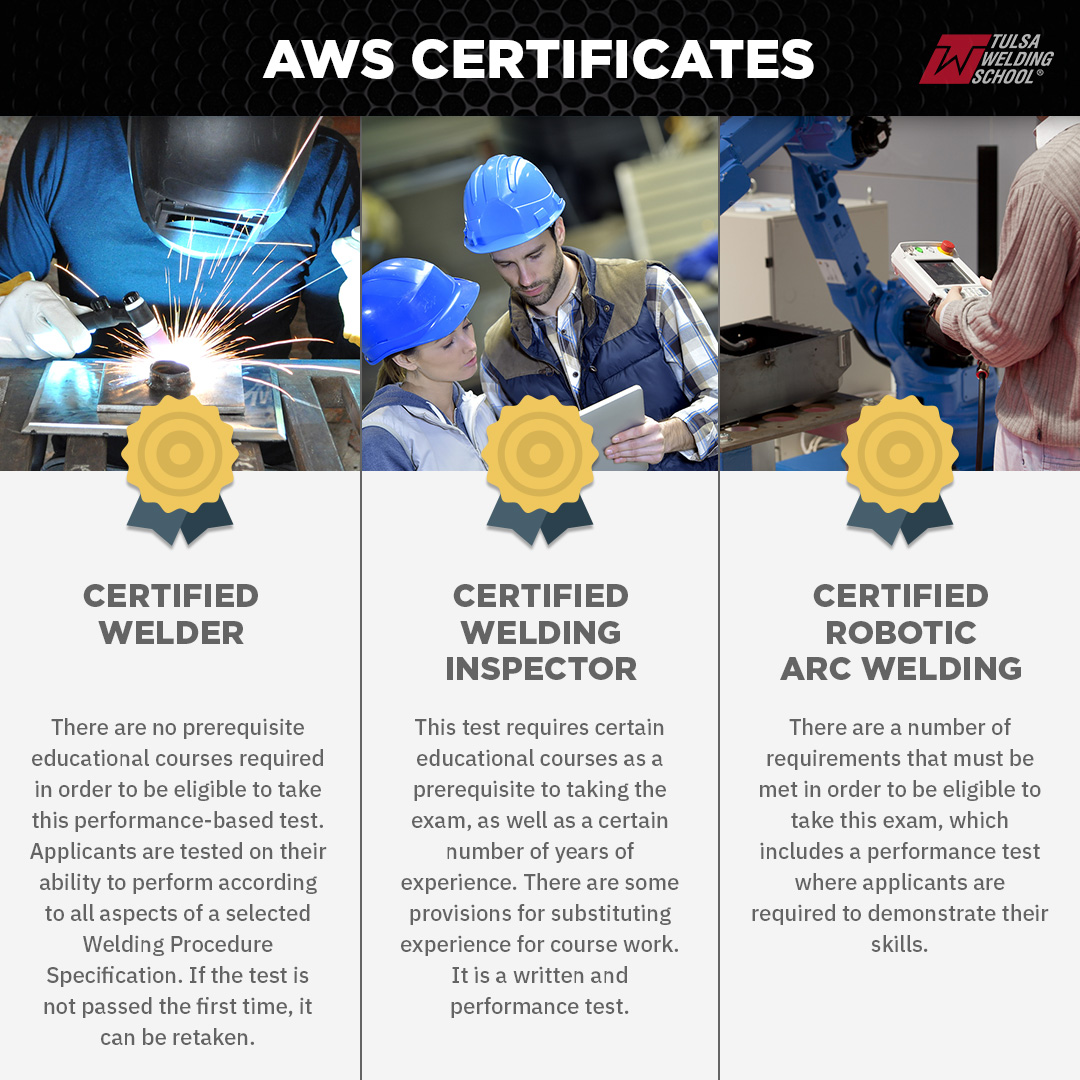
The AWS offers several pathways to welding certification depending on the specific job, goal or education of the welder desiring the certification. For instance, a professional welder needs a different certification than a welding inspector. The AWS partners with the Ironworkers Union and the Sheet Metal Institute to provide welding certification and testing centers to certification applicants.
Here are a few certification options:
- Certified Welder: There are no prerequisite educational courses required in order to be eligible to take this performance-based test. Applicants are tested on their ability to perform according to all aspects of a selected Welding Procedure Specification. If the test is not passed the first time, it can be retaken.
- Certified Welding Inspector: This test requires certain educational courses as a prerequisite to taking the exam, as well as a certain number of years of experience. There are some provisions for substituting experience for course work. It is a written and performance test.
- Certified Robotic Arc Welding: There are a number of requirements that must be met in order to be eligible to take this exam, which includes a performance test where applicants are required to demonstrate their skills.
- Certified Welding Educator (CWE): Designed for those who teach welding at a secondary, post-secondary, or vocational level. Applicants must meet experience and educational prerequisites and pass both written and practical components.
- Certified Welding Supervisor (CWS): For experienced welders moving into supervisory or leadership roles. This credential verifies knowledge of welding processes, codes, quality control, and personnel management within a welding operation.
Certifications from the AWS generally relate to codes dealing with structures such as bridges and buildings.
Types of Welding Certifications: A Quick-Reference List
There are several distinct types of welding certifications, and choosing the right one depends on the industry you’re targeting and the role you want to hold. Here’s a summary of the major options:
| Certification | Issuing Body | Best For |
|---|---|---|
| Certified Welder (CW) | AWS | Entry-level and working welders across industries |
| Certified Welding Inspector (CWI) | AWS | Quality control and inspection roles |
| Certified Robotic Arc Welding (CRAW) | AWS | Automated and robotic welding environments |
| Certified Welding Educator (CWE) | AWS | Those teaching or training welders |
| Certified Welding Supervisor (CWS) | AWS | Welders moving into leadership roles |
| API 1104 | American Petroleum Institute | Pipeline and oil and gas work |
| ASME Section IX | ASME | Pressure vessel and boiler fabrication |
| D1.1 Structural Steel | AWS | Construction and structural fabrication |
Certifications Available from Other Industries
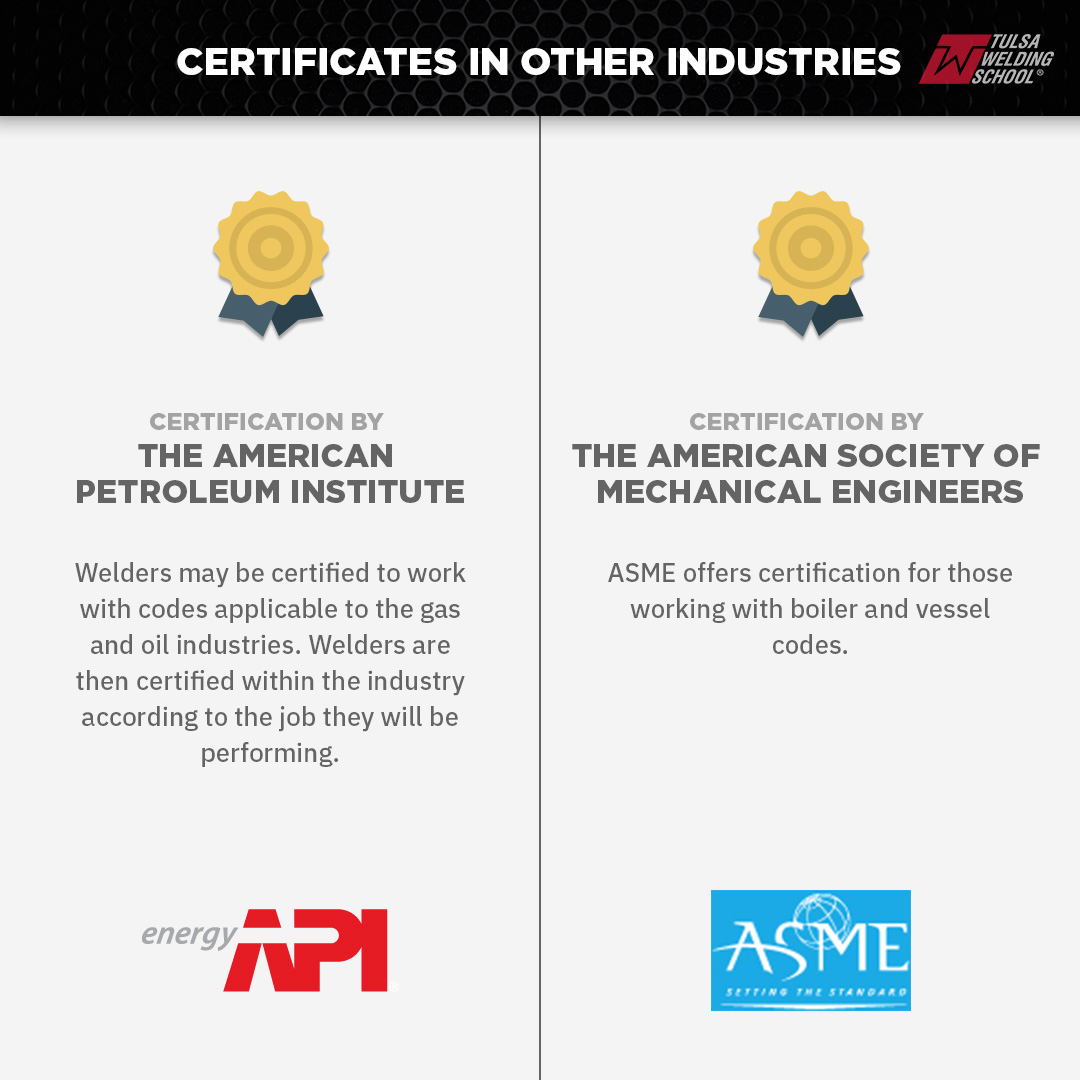
Other industries offer welding certification depending upon the type of welding that is required and the actual work that will be performed. Here are just a few examples.
- Certification by the American Petroleum Institute (API): Welders may be certified to work with codes applicable to the gas and oil industries. Welders are then certified within the industry according to the job they will be performing.
- Certification by the American Society of Mechanical Engineers (ASME): ASME offers certification for those working with boiler and vessel codes.
Welders interested in certification for a specific industry may check with that industry to see if they offer specific welding certification. For additional information on how to become a certified welder, refer to our related blog post.
Licenses for Welders
Some states have licensing requirements for welders in addition to certification. For example, New York requires welders to be certified by the AWS or the N.Y. State Department of Transportation. They then must apply to the state for a license. Some cities have their own certification and licensing processes in order for welders to be employed by the governmental entity. One such city is Los Angeles. Although it has its own testing procedure for certifying and licensing someone to become an L.A. City Certified Welder, applicants are required to bring the applicable codebook published by the AWS to the city’s certification exam. Welders who want to work for a local, state or federal government project need to check with their employer, or anticipated employer, for specific welding certification or licensing requirements.