TWS is a Great Training Option for Everyone
Learn more about how we can prepare you to advance your career.
Dan, 54, was born in Longview, Texas, but moved to Fairbanks, Alaska, as a young child. Dan completed the seven-month Professional Welder program at our Tulsa Welding School campus in Tulsa in March 2000.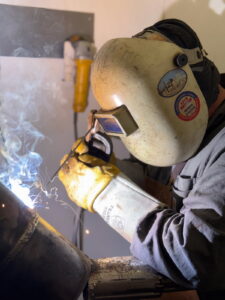
Thanks for your time, Dan. What brought your family from Texas to Alaska?
My dad and my mom came to Alaska in 1973 to work on the Trans Alaska pipeline. I was maybe one or two years old, so I’ve lived in Fairbanks pretty much all my life.
What did you do in the 10 years between high school and enrolling at Tulsa Welding School?
Have You Considered a Career in the Skilled Trades?
Fill out the form to recieve a no obligation info packet.
Right after high school – actually the night of graduation – I met my best friends’ dad – they were twins – for the first time. He had come up to Alaska for their graduation. We were all sitting around a fire having a beer afterward, and he asked us, “Do you guys want to come build pipelines?” We said, “Sure, why not?”
He helped us get jobs as welder helpers, and that’s really how I got started in the trade. For the next couple of years, we traveled all over the country working on pipelines in places like Florida, Iowa, and Wyoming. We were everywhere. After that, I came back to Alaska and looked up the plumbers and pipefitters union in Fairbanks. I called and asked if they needed helpers; they did. I started working up on the North Slope around 1993 or 1994.
What made you decide to go to welding school several years later?
At that point, I was young – 21/22 – and honestly pretty content just being a welder’s helper and going through life. Eventually, though, I went through a rough period a few years later. I was drinking a lot and making bad decisions. In 1999, I got into a serious car wreck, broke my femur, and realized I needed to change my life. I had already thought about welding school, so I called Tulsa Welding School and said, “I need to turn things around.” I actually went to welding school with a broken leg. I flew down to Oklahoma, got myself a bicycle, found a place to stay, got some loans and grants together, and just went for it. It was called the Master Welder program at the time. Looking back, it was one of the best decisions I ever made.
You went into TWS with a lot of experience as a welder’s helper. Did that give you an advantage?
New: Industrial Maintenance
Learn About Our New Advanced Industrial Maintenance Program
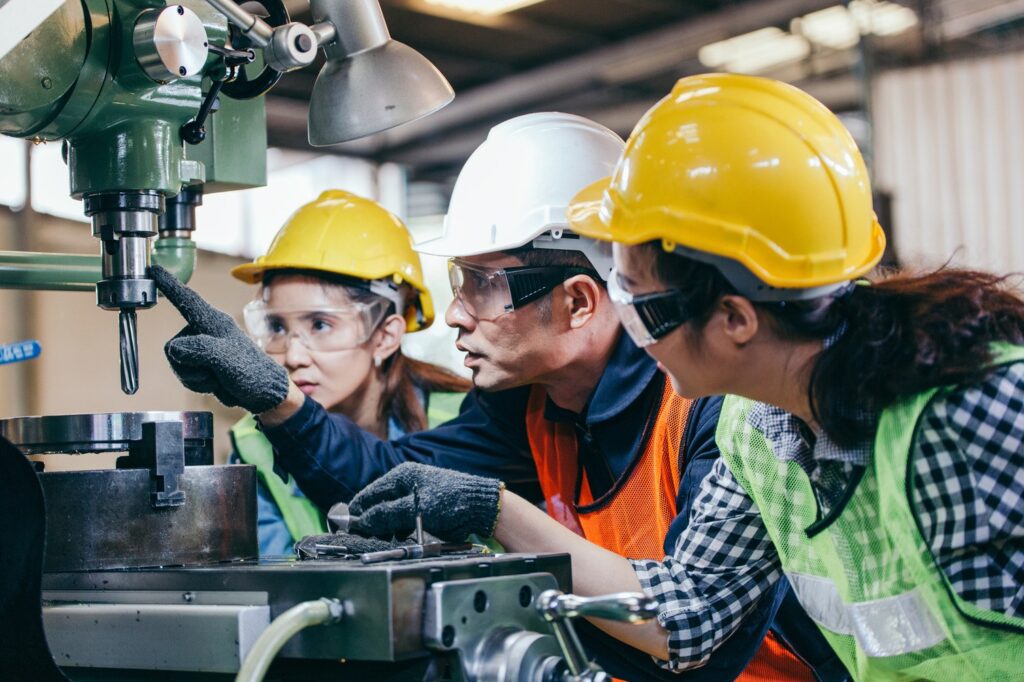
Tulsa Welding School is proud to announce our newest program offering available at our Houston & Dallas Metro Campuses – Advanced Industrial Maintenance Technology! Learn the skills you need to take on the industries of manufacturing, distribution, energy production and facility maintenance in as few as 7 months.
Yeah, definitely in some ways. As a welder’s helper, you do everything except the actual welding. You know the rod sizes, the heat ranges, how to set everything up, and what the welder needs before the weld even starts. So, I understood the process before I ever got to school. That said, I didn’t really have hands-on welding experience. Every once in a while, someone would let me weld something, but I wasn’t actually doing it every day. Still, I was ahead of a lot of students.
It was a long time ago, but what did you enjoy most about your time at Tulsa Welding School?
The biggest thing I remember is just being excited about the future. For the first time, I felt like I had a real direction and a foot in the door. As I went through the program and learned more skills, I kept thinking about what was next – where I might end up and what opportunities were ahead. I had no idea where life would take me, and that was exciting.
I also enjoyed meeting people. There were two other guys from Alaska there at the time, and we became friends. I’m actually still friends with them today 26 years later. What I really appreciated was finally being able to focus on the welding itself. As a helper, people aren’t stopping to teach you technique. They’re telling you to grab rods, move equipment, and keep things running. At TWS, I finally got to dive into the actual craft, and that was really rewarding.
Did welding school come naturally to you, or was it harder than you expected?
It was more challenging than I expected. When I was a helper, I’d watch welders and think, “Man, my job is harder than theirs, and they’re making way more money.” But once I became a welder myself, my perspective completely changed. Suddenly I looked at helpers thinking, “That guy’s got it pretty good.” Welding at a high level is challenging, especially pipeline welding. There’s a lot of pressure and precision involved.
Did you find yourself helping other students who were struggling?
I did. Since I already understood a lot of the basics, I was ahead of some of the other students.
What was your first welding job after graduation?
Finding work back then was harder than it is now because the internet was still pretty new. I didn’t even have a cell phone. I called every number I could find in the phone book for welding jobs in Alaska. My first job was in Healy, AK. I think I was making around $18 an hour, but I had to pay for my own room and board. It was a small family-owned operation, and I worked on everything from dump trucks to random equipment repairs. I only stayed there a couple of months, but it gave me my start as an actual welder.
Next, I moved back to Fairbanks and started welding snowmobile trailers and car trailers at a manufacturing shop. Then, out of nowhere, I got a call from the United Association of Plumbers and Pipefitters. Tulsa Welding School had apparently partnered with them as a recruiting source and gave them my number.
The guy I spoke to said I was exactly the person they were looking for, someone with years of helper experience who now had welding training. That call in March 2001 completely changed my life. I took my welding and pipefitting tests and eventually joined Local 367 out of Anchorage to become a union welder.
What kind of work have you done over the last 25 years as a union welder?
I’ve done a little bit of everything. I’ve worked on military bases, utility systems, steam lines, commercial buildings, and new construction projects. But pipeline work has definitely been my main specialty and biggest source of income over the years.
For people unfamiliar with union welding, how does it work?
The union is basically like a job service combined with benefits management. Contractors call the union and say they need welders, helpers, or pipefitters for a project, and the union fills those jobs from a list of members. The contractor pays me directly, but all my benefits – retirement, health insurance, and everything else – go through the union. The nice thing is that no matter how many contractors I work for, all my benefits stay in one place instead of being spread across multiple employers. At this point in my career, I usually know where I’m going before the union even calls because I’ve built relationships and a network over the years.
What’s next for you career-wise?
This past year was a big milestone because I was asked to be the welder boss on a major Alaska pipeline project called the Willow Project. That means overseeing welders, helpers, pipefitters, and foremen on the job. It’s a different kind of challenge because it’s more management and coordination instead of welding itself. But I still go back and forth depending on the project. One job I might be welding, the next I might be supervising. I’m happy doing whatever the job needs. I’m going to keep doing what I’m doing.
What do you love most about welding?
I love the competitiveness of it. In pipeline welding, every weld gets X-rayed. If your quality slips, there’s always somebody younger and hungry ready to take your place. That pressure pushes you to keep improving no matter how long you’ve been doing it. When I started, I was the youngest guy on the crew. Now I’m usually the oldest. But I still enjoy trying to stay sharp and keep up. Welding has also given me an incredible life. It’s taken me all over the country, allowed me to provide for my family, and helped me build a good living. I have nine kids aged 34 to 19, so I definitely needed steady work.
What advice would you give new students starting at Tulsa Welding School?
Treat it like a job. That’s the biggest thing. A lot of students get caught up in the social side of school, but I went there to work. Tulsa Welding School gives you the opportunity to become a really skilled welder if you put the effort in. But nobody is going to force you to succeed. You can coast through and get the diploma, but that doesn’t mean you’ll actually be ready for the field. If you really apply yourself, though, there’s serious money and opportunity in welding. Right now, depending on the project, I can make $70-$80 an hour plus benefits, that adds up to $6,000 a week this past winter. There’s definitely a great living to be made in this trade if you’re willing to put in the work.
If you’re a TWS graduate and would like to share your success and be an inspiration to others, please email [email protected] to be considered for a Graduate Connection interview. Please include details such as your graduation date (month/year), program, and campus name (Tulsa/Jacksonville/Houston/Dallas/Atlanta).