Key Takeaways
- The 2021 Texas blackouts began with equipment failures, as power plants tripped offline and extreme cold froze equipment across the state.
- Texas accounts for 53% of the battery storage capacity planned nationwide for 2026, and its grid operator expects large new loads from data centers, crypto mining, and industrial sites.
- A Texas journeyman license requires 8,000 hours of supervised work, and electricians account for more active apprentices than any other occupation in the state.
TWS is a Great Training Option for Everyone
Learn more about how we can prepare you to advance your career.
Winter Storm Uri pushed the Texas power grid into days of rolling blackouts in February 2021, and the storm killed at least 246 people. Five years later, the grid faces a different kind of pressure. Data centers, industrial projects, solar farms, and battery sites are adding load and complexity faster than the system has ever grown.
Every one of those projects runs on equipment that electricians install and maintain, from switchgear and transformers to solar inverters and battery banks. For electrical work in Texas, that growth means steady demand for electricians trained on heavier, more complex systems than a typical home.
What the 2021 Freeze Revealed About the Texas Power Grid
The grid lost about 1,500 megawatts of generation within minutes on Feb. 15, 2021, as power plants tripped offline. More failures followed as extreme cold frozen equipment and fuel supply problems spread across the system.
The Electric Reliability Council of Texas (ERCOT) then cut power to millions of customers for days to keep the grid from collapsing. Those rolling outages left millions of Texans without heat or power for days in subfreezing temperatures.
Have You Considered a Career in the Skilled Trades?
Fill out the form to recieve a no obligation info packet.
During the winter 2026 storms, federal regulators thankfully found no significant disruptions in the nation’s electric or natural gas systems. Their review credited several changes made since earlier winter failures:
- Cold weather standards: Generators now follow mandatory cold weather reliability standards.
- Lessons from past storms: Grid operators and generators put recommendations from previous winter storm reports into practice.
- Earlier preparation: Generators committed to run ahead of the cold, and operators had better situational awareness as conditions changed.
- Emergency orders: Federal emergency orders kept additional generating resources available during the storms.
Texas also had a resource it lacked in 2021. During the January 2026 storm, batteries briefly supplied 9.5% of the state grid’s power, generating more than 7,000 megawatts.
The grid still had little room to spare. Generator outages during the 2026 storms were similar in size to those in January 2025, and reliability problems over several days pushed the system close to failure. The review called for more natural gas infrastructure, better coordination between gas and electric companies, and improved load forecasting, and every one of those fixes depends on equipment that electricians install, protect, and maintain.
Why Strain on the Texas Power Grid Keeps Climbing
Winter weather is no longer the only stress test. ERCOT’s preliminary forecast projects about 367,790 MW by 2032, compared with an all-time peak of 85,508 MW set in August 2023. ERCOT expects actual growth to come in lower than that forecast, but even a fraction of it would reshape the grid.
The largest new loads come from four kinds of customers, and each draws power at a scale that calls for careful load calculations, transformer sizing, and protective equipment:
- Data centers: Servers and cooling systems run around the clock, so power quality and backup systems have to hold up under constant demand.
- Cryptocurrency mining: Mining operations pull heavy, steady loads from large banks of computing equipment.
- Industrial sites: New plants bring three-phase motors, automated controls, and large service entrances.
- Oil and gas processing: Pumps, compressors, and control systems at processing facilities depend on uninterrupted power.
Supply is changing at the same pace. Texas accounts for 53% of planned U.S. battery storage additions in 2026, about 12.9 GW, along with 40% of new utility-scale solar capacity. Solar’s share of ERCOT generation rose from 4% to 12% between 2021 and 2025, while coal’s share fell from 19% to 13%.
What Electrical Training Now Needs to Cover
Electrician employment is projected to grow 9% from 2025 to 2035, with about 72,700 openings each year. Growth in AI and data centers means the national grid needs upgrades and new infrastructure, creating work for electricians who connect power generation sources to the grid.
Each source of grid growth calls for a specific set of electrical skills, all grounded in the National Electrical Code (NEC):
| Grid pressure | Skills it demands | Why it matters on the job |
|---|---|---|
| Solar and battery storage buildout | Photovoltaic (PV) system concepts, design, and installation wiring | Solar and storage sites need electricians who can wire and protect them to code |
| Large industrial and data center loads | Load calculations, three-phase motor wiring, transformer sizing, switchgear | Undersized equipment fails under heavy, constant demand |
| Heavier loads on existing equipment | Overcurrent protection, fuse and breaker sizing, grounding and bonding | Proper protection keeps a fault from spreading or starting a fire |
| Automated controls at plants and facilities | Motor controllers, overload protection, programmable logic controller (PLC) programming | Plants and processing sites run on automated equipment that electricians install and troubleshoot |
The Electrical Technologies program at Tulsa Welding School (TWS) covers each of these areas through courses in solar fundamentals, commercial wiring, electrical distribution systems, and motors and PLCs.
How to Become an Electrician in Texas
Learning how to become an electrician in Texas starts with the state’s licensing rules, which treat electrical work as a licensed trade from the first day on the job. Anyone performing electrical work in the state must be licensed, with limited exemptions, and the path to a journeyman license follows five steps:
- Register as an apprentice electrician: The apprentice license requires no prior experience or exam, and apprentices work under the supervision of a master electrician, journeyman electrician, or residential wireman.
- Build fundamentals in the classroom: Training in code, wiring methods, and load calculations before or alongside an apprenticeship prepares new apprentices for the work they’ll do under supervision.
- Log supervised hours: Journeyman candidates need 8,000 hours of training under a Texas-licensed master electrician, and each supervisor signs an Experience Verification Form.
- Take the journeyman exam: Candidates can apply to take the test once they reach 7,000 hours.
- Earn the journeyman license: With all 8,000 hours verified and the exam passed, a journeyman can perform electrical work under the general supervision of a master electrician.
At a full-time schedule of roughly 2,000 working hours a year, the 8,000-hour requirement works out to about four years of supervised work.
Finding an Electrician Apprenticeship in Texas
Apprenticeships give most new electricians their start. The electrician apprenticeship Texas employers offer draws more participants than any other occupation in the state’s latest apprenticeship report, with 108 registered programs and 9,973 active electrician apprentices out of about 35,585 apprentices statewide.
Registered apprenticeships follow an “earn while you learn” model, so apprentices collect a paycheck while logging hours. Because journeyman hours must be logged under a Texas-licensed master electrician, an apprenticeship or an employer-sponsored training position is the practical route to licensure for most Texas electricians.
Preparing for an Electrical Apprenticeship
Classroom training and an apprenticeship do different jobs. An apprenticeship is paid, supervised work that counts toward a license, while a training program builds the fundamentals beforehand so an apprentice spends less time learning the basics on the clock. Apprentice candidates who arrive with that preparation bring skills employers can put to work early:
- Code knowledge: They can find and apply National Electrical Code requirements instead of learning the book from scratch on the job.
- Conduit and wiring skills: They already know how to bend conduit, pull wire, and terminate conductors neatly.
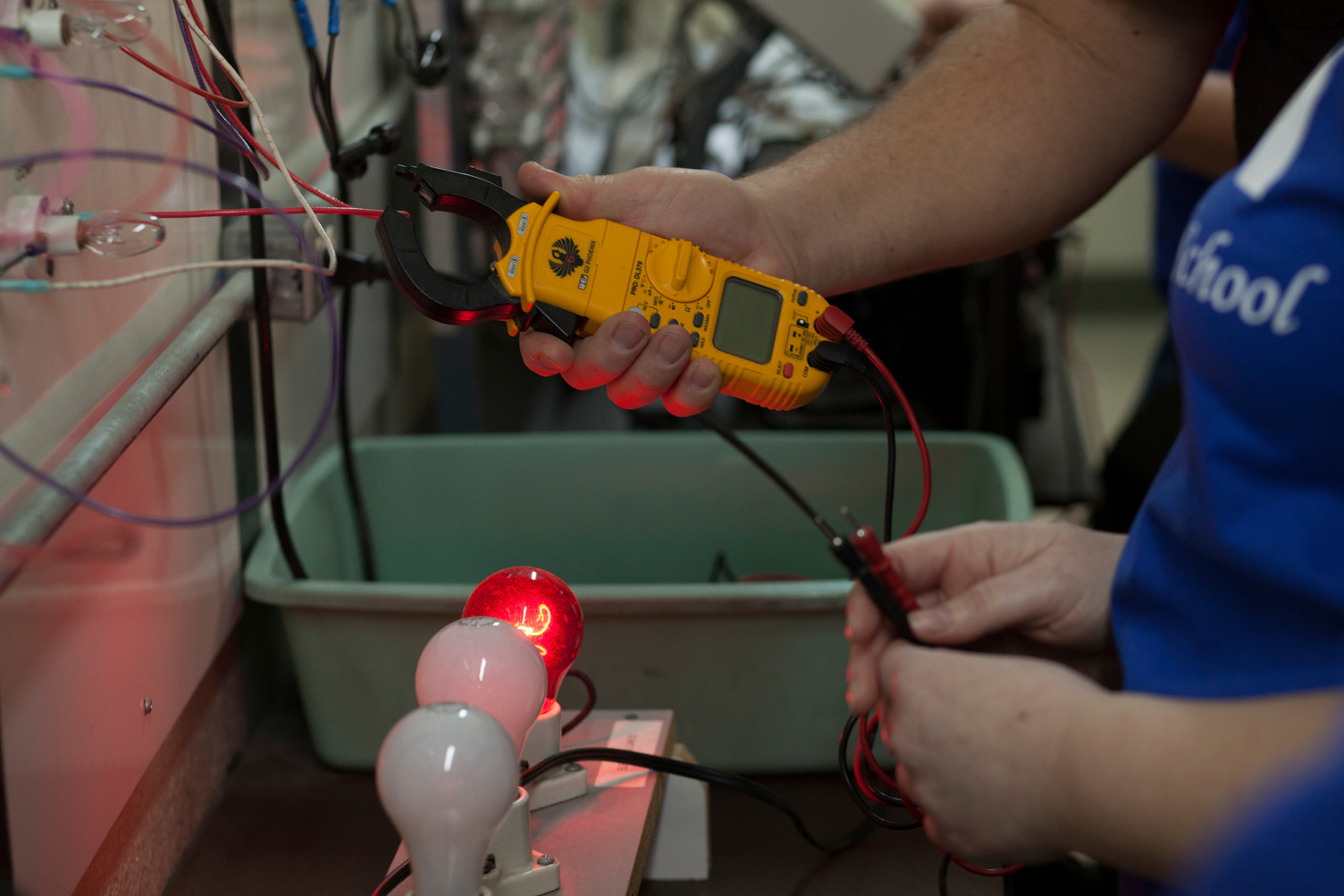
- Troubleshooting basics: They can use a multimeter to check voltage, current, and resistance and trace a fault through a circuit.
More of their supervised time then goes toward the installation, troubleshooting, and code work that counts toward a journeyman license. Training programs like Electrical Technologies at TWS cover these fundamentals in about seven months, before any apprenticeship hours begin.
The Texas power grid is growing more complex every year, and it needs electricians who can work on it with precision from their first shift.
For more information on the Electrical Technologies program, class schedules, start dates, and financial aid, reach out to TWS and connect with an admissions representative.