TWS is a Great Training Option for Everyone
Learn more about how we can prepare you to advance your career.
Choosing between trade school and community college is not about picking the more respectable option. Both are legitimate, and both can lead to careers in skilled trades like welding and electrical work. The question is which one fits where you are right now and where you are trying to go.
The differences worth understanding are not about which is universally better. They are about scope, depth, and learning structure, and how each one maps to what a specific student is trying to accomplish.
Narrow Focus vs. Broad Foundation
Trade schools are built around a specific skill set in contrast to community college and traditional four-year degrees. Depending on the school, trade school students can earn a diploma, certificate, or degree, but the curriculum stays tightly focused on the trade itself with little room for coursework outside that discipline. That is by design.
Community colleges take a wider approach. Students may pursue a specific major, a general education track, or a two-year degree in a technical field. Either way, the experience is built to give them a broader foundation, one that supports pivoting, stacking credentials, or continuing toward a bachelor’s degree. A community college background does not disappear if someone later decides to pursue a trade. The academic depth can be an advantage in more advanced trades roles, such as supervision, inspection, and project coordination, where that broader foundation gets used.
Have You Considered a Career in the Skilled Trades?
Fill out the form to recieve a no obligation info packet.
Trade school is not a ceiling, either. Graduates can always return to school later if they want.
What That Looks Like in the Classroom and the Lab
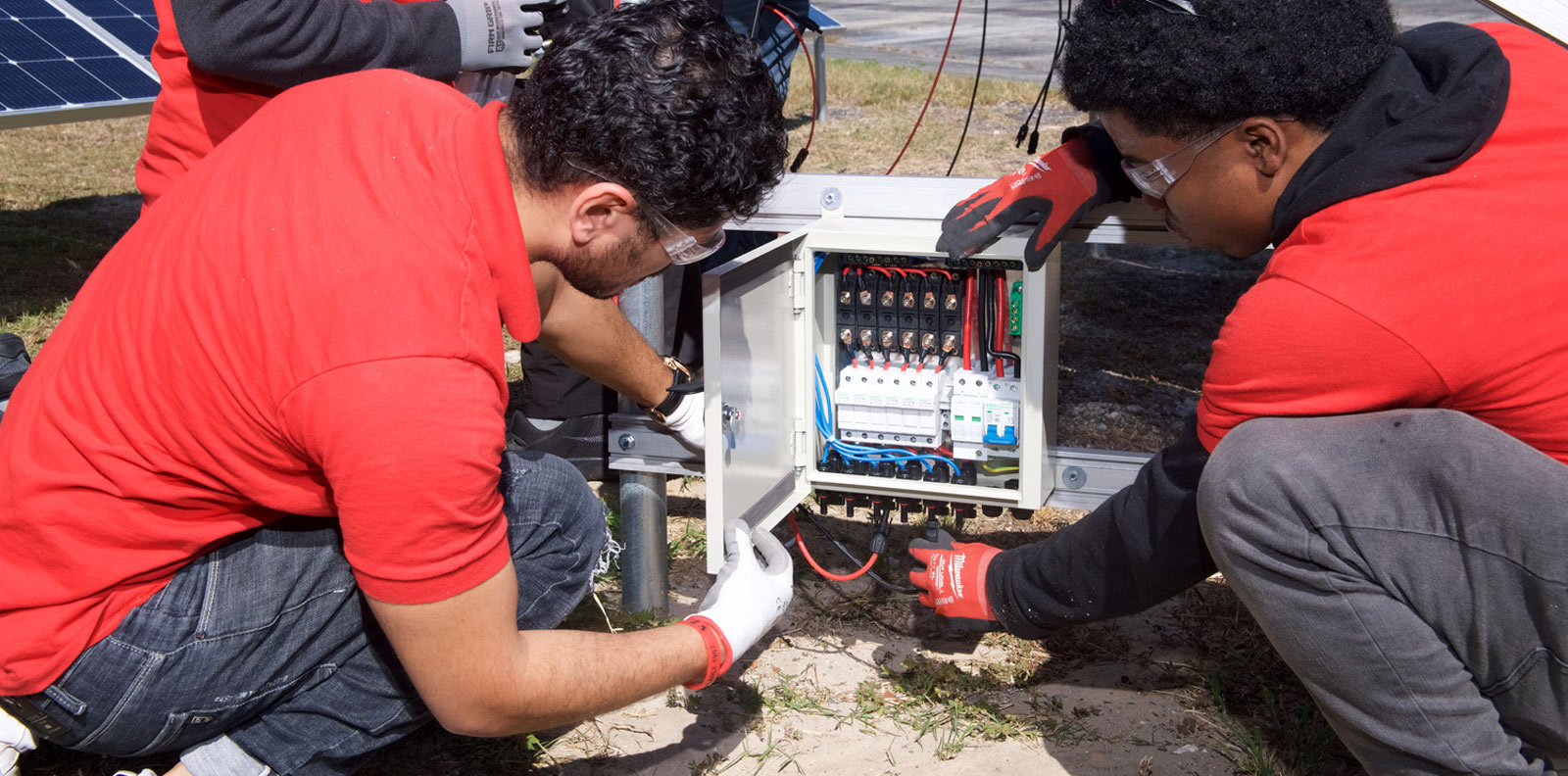
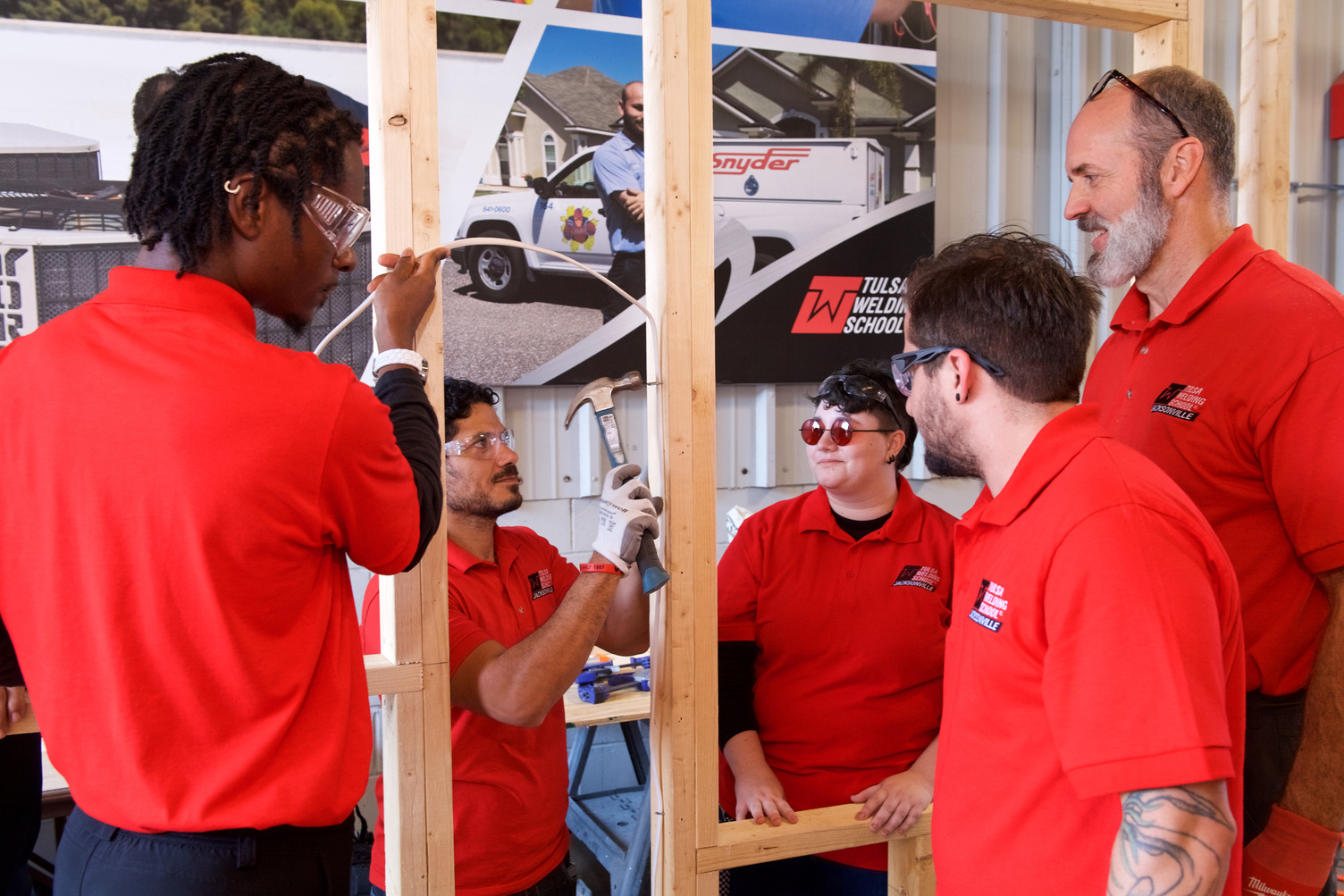
In a trade school program, the majority of training time is spent in the lab working with actual equipment. Lecture and theory still happen, but the ratio tilts heavily toward applied work throughout the entire program.
Community college programs can vary more widely in how they balance lecture, theory, and hands-on time. Some programs are lab-heavy; others weigh general education and theory more heavily, particularly in the first year. Program structure differs by school and by discipline, so the experience at one community college can look quite different from another.
That proportion of lab time to lecture matters most for students who learn by doing. A student who spends the first stretch of a program working through general education requirements before getting into a booth is not logging the same practice time as one working with equipment from week one.
Getting Into the Field Faster
Program length is one of the most practical differences between the two paths. Here is how the timelines generally compare for students interested in welding and electrical trades.

New: Industrial Maintenance
Learn About Our New Advanced Industrial Maintenance Program
Tulsa Welding School is proud to announce our newest program offering available at our Houston & Dallas Metro Campuses – Advanced Industrial Maintenance Technology! Learn the skills you need to take on the industries of manufacturing, distribution, energy production and facility maintenance in as few as 7 months.
| Path | Typical Program Length | Credential |
|---|---|---|
| Trade school (certificate or diploma) | 7 months to 1 year | Certificate or diploma |
| Trade school (degree) | 1 to 2 years | Associate degree |
| Community college | 2 years | Associate degree |
A shorter program means a student can complete training and begin pursuing entry-level work sooner. A longer program can provide more depth, including advanced theory, broader technical exposure, and preparation for roles that require more than entry-level credentials.
Neither timeline is inherently better. The right question is whether the depth of a longer program is necessary for where the student wants to go, and whether they are in a position to make a two-year commitment.
Does the Credential Type Matter to Employers?
In skilled trades, employers weigh demonstrated skill and industry credentials alongside the type of diploma a candidate holds.
Many prefer candidates who have completed a training or credentialing program over those who rely on a diploma and on-the-job training alone. A certificate from an accredited trade school, backed by verified hands-on competency, carries real weight. An associate degree can open doors to roles that involve more responsibility, such as welding inspection or project supervision, where academic depth is part of the job.
What matters most is whether the institution is accredited and whether the training behind the credential maps to what employers in that trade actually evaluate at hiring.
What to Look for Inside a Program Before You Commit
Two different programs in the same trade can deliver very different training experiences. The difference lies in how much time students spend working with equipment, how many techniques or applications are covered, and who is doing the teaching. Those factors apply whether you are evaluating a trade school or a community college.
Depth of Technical Coverage
For example, in welding, the key question is how many processes the program trains. Most welding programs cover the four primary arc welding processes, each representing a different set of applications and a different category of jobs a graduate can pursue. TWS’s welding program, for example, trains across all four.
| Process | Common Name | Typical Applications |
|---|---|---|
| SMAW | Stick welding | Structural steel, pipeline, heavy repair |
| GMAW | MIG welding | Manufacturing, automotive, sheet metal |
| FCAW | Flux-core welding | Construction, shipbuilding, heavy fabrication |
| GTAW | TIG welding | Aerospace, precision work, thin and exotic metals |
A program that trains on one or two processes narrows a graduate’s options considerably. More processes covered means access to a wider range of roles and more AWS certification pathways a graduate can pursue after completing the program, since the AWS Certified Welder credential is process and position specific.
For electrical programs, the scope question is similar. Electricians work across three distinct environments, each with different systems, codes, and technical demands:
- Residential: wiring and electrical systems in homes and apartment complexes
- Commercial: office buildings, retail stores, and other commercial properties
- Industrial: factories, plants, and other industrial facilities
A program that covers all three prepares a graduate to pursue a broader range of entry-level roles. One focused only on residential limits that a graduate can immediately step into.
Instructor Background
In hands-on trades, who teaches matters as much as what the curriculum covers. Instructors who have worked in the field bring a different quality of correction to lab work. They recognize the habits that cause welds to fail inspection or wiring to fail a code review, and they address those habits before they stick.
Worth asking any program directly: what is the professional background of the instructors teaching in the lab? There is a meaningful difference between someone who has taught welding and someone who has done it.
Accreditation
Accreditation affects two things that matter to students: access to federal financial aid and how a credential is perceived by employers.
To participate in federal Title IV programs, which include Pell Grants and Direct Loans, a school must be accredited by an agency recognized by the U.S. Department of Education. Without that accreditation, students have no path to that funding. For some occupations, employers and licensing boards also require programmatic accreditation specifically, which is a separate layer from institutional accreditation.
Both trade schools and community colleges can hold recognized accreditation, but not all do. Confirming which agency covers a program and whether that agency is recognized by the Department of Education is worth doing before enrolling anywhere.
Questions Worth Asking on Any Campus Visit
A campus visit closes the gap between what a program advertises and what it actually delivers. These questions apply whether the campus is a trade school or a community college.
- What percent of training time is spent in the lab versus the classroom?
- How many processes, techniques, or technical applications does the program cover?
- Do instructors have field experience in the trade they are teaching?
- What does career services support look like after graduation?
- Is the school accredited, and by which agency?
A program that answers these directly and backs it up on the tour is worth serious consideration. When answers stay vague, with broad claims about “industry partnerships” or “real-world training” offered without specifics, that is a signal to dig deeper before committing.
When Community College Is the Right Call
A two-year welding or electrical program is not a slower version of trade school. For some students, it is the best fit.
Students aiming for inspection roles should know that earning the AWS Certified Welding Inspector (CWI) credential requires passing a three-part examination covering welding fundamentals, practical applications, and code knowledge, along with documented education and work experience requirements. The academic depth of a program like a Welding Technology associate degree, for example, can build a stronger foundation for that path than a shorter diploma program.
Community college may be a better starting point for students who:
- Are still exploring whether a specific trade is the right direction and want more time before committing fully
- The option to transfer credits toward a four-year degree. Most universities will not accept trade school credits, making community college the more flexible starting point.
- Are interested in supervision, project coordination, or roles that reward broader technical and academic preparation
The decision comes down to where the student is, what they are aiming for, and how much time they can realistically commit. Both paths can lead to a career in skilled trades. The one that fits depends on the individual.
See What Focused, Hands-On Training Looks Like
If a hands-on trade is the direction, and you want to see what a program built around applied skill looks like in practice, TWS is worth a visit. Bring the questions above, walk the campus, and see the training firsthand before you decide.
Schedule a tour or request more information to get started on your career journey today.