TWS is a Great Training Option for Everyone
Learn more about how we can prepare you to advance your career.
Picture two people who both want to work in the trades. One wants to wire homes and commercial buildings, eventually running their own crew. The other is drawn to keeping industrial machines running, diagnosing systems where electrical controls and mechanical components work together.
Both paths start with electricity. Both involve hands-on technical work. But the training, the daily environment, and where each path leads look different enough that choosing between them is worth thinking through carefully.
What Should a Good Electrician Training Program Cover?
Not all electrical programs are built the same. Some focus heavily on theory. Others rush through the fundamentals without giving students enough time in the lab to build real skill. A program worth your time does both and prepares you for the kind of work employers actually need.
At minimum, a solid electrician training program should cover:
Have You Considered a Career in the Skilled Trades?
Fill out the form to recieve a no obligation info packet.
- National Electrical Code (NEC). The NEC sets the safety standards for electrical installation across the country. Understanding how to read and apply it is non-negotiable on any job site.
- Residential and commercial wiring. Students should learn how to wire both types of buildings, not just one. The systems are different, and the code requirements shift depending on what you’re working on.
- Blueprint reading. Electricians work from drawings. Reading a schematic or electrical plan accurately prevents mistakes that are expensive to fix after the fact.
- Conduit work. Running conduit through walls, bending it to fit a space, and protecting wiring inside commercial and industrial structures is a core hands-on skill.
- Load calculations. Sizing circuits correctly keeps systems from overloading. It’s one of the more technical skills in the trade, and a good program works it into the curriculum.
- Safety protocols. OSHA standards apply to every electrical work environment. Students should understand lockout/tagout procedures, PPE requirements, and how to work safely around live systems.
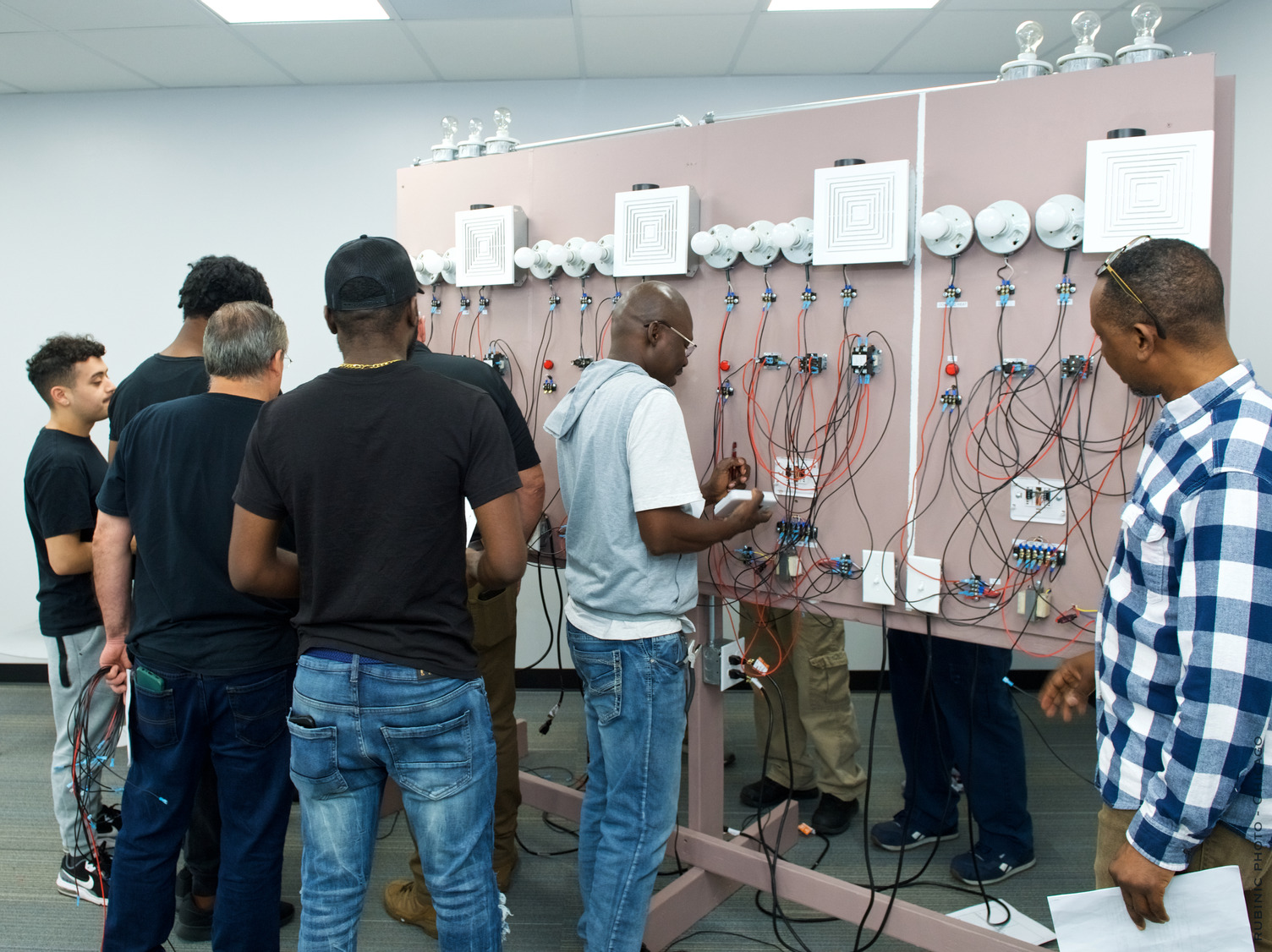
Hands-on lab time separates average programs from strong ones. At Tulsa Welding School (TWS), Electrical Technologies students don’t just read about wiring. They wire a scaled-down three-bedroom home and a commercial building with lighting, putting code into practice in a real trainer environment.
Certification preparation matters too. Look for programs that position students for entry-level credentials and give them enough applied experience to hit the ground running once they’re hired.
Electro-Mechanical Training Covers More Ground
Electrical training focuses on power systems in buildings. Electro-mechanical training goes wider.
An electro-mechanical technician works at the intersection of electrical controls and mechanical systems. That might mean keeping an HVAC unit running in a commercial facility, maintaining automated equipment on a manufacturing line, or troubleshooting a system where a failing sensor is causing a mechanical component to behave erratically. The work requires understanding both sides of the problem.
TWS’s Electromechanical Technologies program builds on electrical fundamentals and adds:
- HVAC/R systems, including the refrigeration cycle and residential and commercial comfort systems
- Programmable logic controllers (PLCs) and basic automation
- Schematic wiring and blueprint reading for complex systems
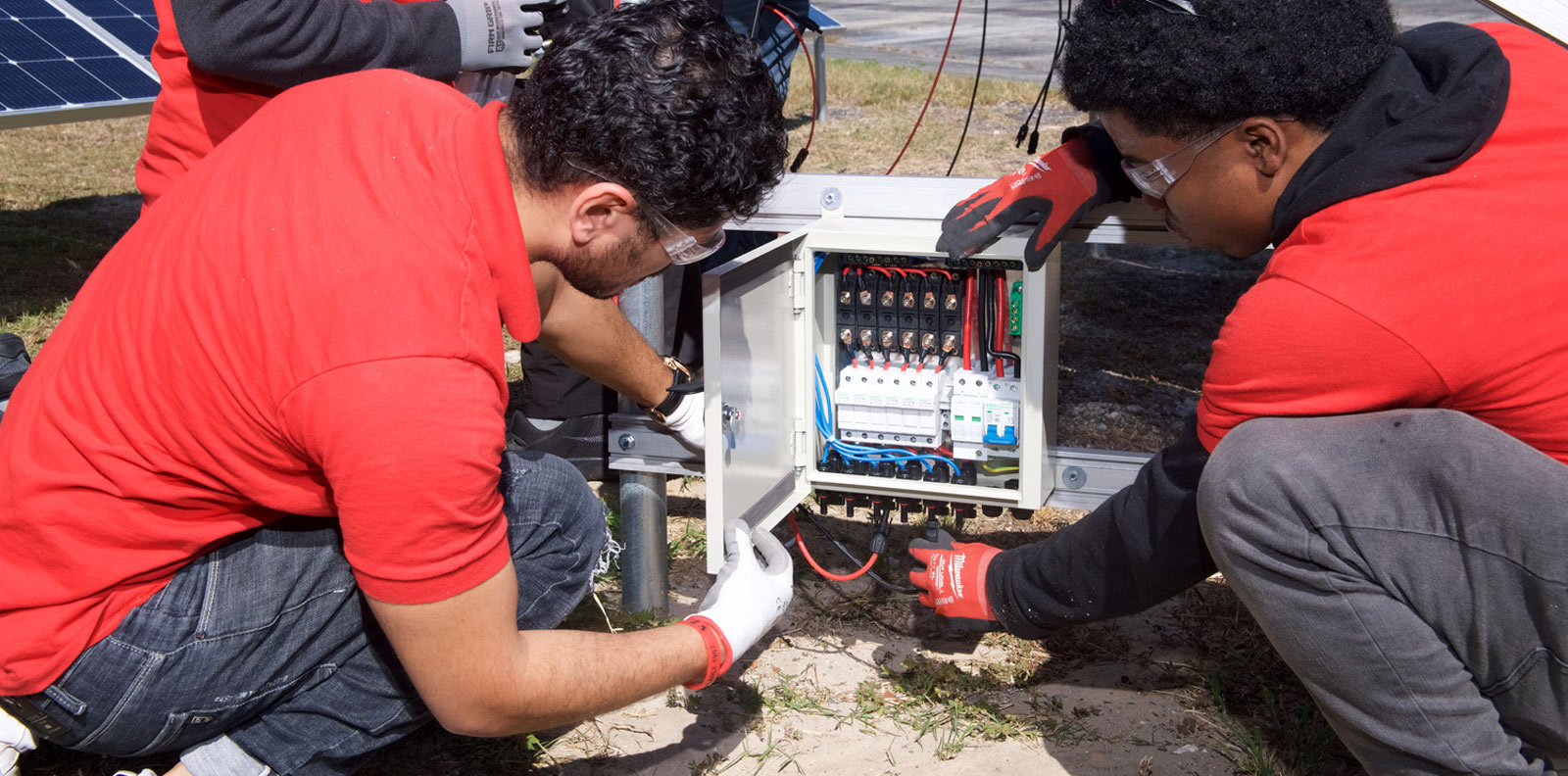
- A solar energy module covering photovoltaic (PV) science and installation
- Preparation for the EPA Section 608 certification, which is required to work with refrigerants
This path is a strong fit for students who want to work in manufacturing, energy, facilities management, or any industry where electrical and mechanical systems operate together.
Is Residential or Commercial Electrical Work Better to Start With?
Both electrical and electro-mechanical training can prepare students to work across varying work environments. The question isn’t which one is better in the abstract, however, it’s which environment matches how you want to spend your working day.
For example, here’s how residential and commercial electrical work compare:
| Detail | Residential | Commercial |
|---|---|---|
| Power system | Single-phase, 120/240V | Three-phase, often 480V or higher |
| Wiring materials | Non-metallic sheathed cable (Romex) | EMT conduit, industrial-grade materials |
| Work environment | Homes, apartments, occupied living spaces | Office buildings, retail, schools, hospitals |
| Team size | Solo or small team | Larger crews alongside HVAC technicians, plumbers, and general contractors |
| Schedule | Variable, based on service calls and homeowner availability | More structured, often planned well in advance |
| Customer interaction | High, working directly with homeowners | Lower, coordinating with project teams |
| Entrepreneurship | Easier to start your own operation | More complex, larger capital and licensing requirements |
| Advancement pace | Steady | Faster advancement to foreman and project manager roles |
Residential work gives new electricians faster exposure to hands-on service calls and direct problem-solving in people’s homes. It’s also a more accessible path to eventually running your own business. Commercial work involves larger, more complex systems and tends to offer a more structured environment, along with higher long-term earning potential as you move up.
Neither is the wrong place to start. Strong electrical training covers both, which means you build the foundation first and specialize once you’re in the field.
What Does Troubleshooting Look Like for an Electrician on a Real Job?
Troubleshooting looks different depending on which path you’re on, and understanding that difference is part of choosing the right training.
On the electrical side, the work is typically contained. A homeowner reports that two rooms lost power. You check the panel, find a tripped breaker, and trace the circuit. Common culprits include:
- Damaged or nicked wire in the run
- An overloaded circuit pulling too much current
- A loose connection at an outlet or junction box
The tools are a multimeter, a circuit tester, and a solid understanding of how the panel is mapped. The problem has a starting point and a logical path to the answer.
On the electro-mechanical side, the scope is broader. A rooftop HVAC unit stops heating a commercial building. The cause could be electrical or mechanical, and you have to work through both. Possible failure points include:
- A failed contactor or wiring issue in the control circuit
- A worn fan motor or compressor component
- A refrigerant leak affecting system pressure
- A malfunctioning sensor sending bad data to the controls
Technicians use multimeters, torque wrenches, and software-based diagnostic tools to narrow it down. Reading a schematic and understanding how the electrical controls interact with the mechanical components is how you find it.
Training should put students in situations that reflect this. TWS Electrical Applications students work through residential and commercial wiring scenarios in hands-on trainer setups. Electromechanical Technologies students use the E-STAR Trainer, equipment built specifically to develop both electrical and mechanical troubleshooting skills in a single session. By the time they graduate, the diagnostic process isn’t new territory.
The Work Environments Are Different, and So Is the Day-to-Day
Choosing between these two paths isn’t just about the technical content. It’s about where you want to work and what kind of problems you want to solve.
Electricians typically work in homes, businesses, factories, and construction sites. A typical week might include:
- Service calls to diagnose and repair problems in occupied homes or businesses
- New installs on a construction site, working from a blueprint to bring a building’s electrical system online
- Inspections, panel upgrades, and code compliance work
You interact regularly with homeowners, property managers, and general contractors, so communication is part of the job.
Electromechanical technicians more often work in manufacturing industries, energy, and at production sites. A typical week might look like:
- Scheduled maintenance on HVAC or industrial equipment to prevent downtime
- Diagnosing a failed system using schematics and diagnostic tools
- Calibrating sensors, controls, or automated components
- Working alongside other technical specialists on larger mechanical systems
Neither path is inherently harder. They attract different kinds of people. Students who like the variety of service work and solving a customer’s immediate problem tend to do well in electrical. Students who prefer working with complex systems and thinking through layered mechanical and electrical problems often find the electro-mechanical path more engaging.
Matching the Program to Your Career Goals
If you’re still deciding, here’s a straightforward way to think through it:
- Choose electrical training if you want to wire homes and commercial buildings and build toward a journeyman license. From there, the path can lead to master electrician status, project management on larger commercial jobs, or running your own electrical contracting business. Electricians who specialize in solar installation, EV charging infrastructure, or industrial controls also open doors into growing sectors that didn’t exist a decade ago.
- Choose electro-mechanical training if you want to work in manufacturing, HVAC/R, automation, or energy with a skill set that spans both systems. Long-term, that foundation supports roles in facilities management, industrial maintenance supervision, controls engineering support, or technical specialist positions in industries where automated systems and robotics are expanding.
- If you’re not sure yet, that’s a normal place to be. Think about the environments described above and ask yourself which one sounds more like a place you’d want to spend your days — not just in year one, but in year ten.
Both programs at TWS are built around hands-on training taught by instructors with real industry experience. Both include a gear package and access to Career Services support after graduation, which means you’re not on your own when it’s time to find a job.
The technical work is demanding in either direction. The difference is in where you’ll be doing it and what kinds of problems you’ll be solving every day.
If you’re ready to see what the training actually looks like, request more information or schedule a tour to walk through a campus and talk to someone about which program fits where you want to go.