TWS is a Great Training Option for Everyone
Learn more about how we can prepare you to advance your career.
Oil refineries, petrochemical plants, shipyards, and pipeline contractors stretch from Houston across the Texas coast and into Louisiana, and all of them run on skilled welders.
The American Welding Society (AWS) projects around 80,000 welding job openings nationally per year through 2029, with more than 157,000 working welders approaching retirement age. The pipeline of new welders entering the field is not keeping pace, and the Gulf Coast feels that gap more than most regions.
If welding has been on your radar, this is a market where that interest has real traction.
What Welding Jobs Actually Look Like on the Gulf Coast
Houston accounts for 41% of U.S. based petrochemical production capacity, and energy-related industries directly employ more than 220,000 people in the region. The roles available to entry-level welders include structural welder, pipe welder, welder/fabricator, combo welder, and maintenance welder, spread across oil refineries, petrochemical plants, fabrication shops, pipeline contractors, shipyards, and liquefied natural gas (LNG) export facilities.
Have You Considered a Career in the Skilled Trades?
Fill out the form to recieve a no obligation info packet.
Companies across the Gulf Coast have reported project delays tied directly to a shortage of qualified welders. AWS data puts 320,500 welding openings nationally by 2029, and the Gulf Coast’s concentration of energy infrastructure means this region pulls a significant share of that demand.
Most entry-level roles involve reading blueprints, preparing metal surfaces, and executing welds to a specified procedure. In high-consequence environments like refineries and pipelines, every weld is documented and inspected.
Where Gulf Coast Welders Work
- Refineries and petrochemical plants along the Houston Ship Channel are among the highest-volume employers of welders in the region. Plant turnarounds — scheduled shutdowns where deferred repairs get done all at once — keep welding crews working consistently.
- Fabrication shops produce pipe spools, structural steel components, and industrial equipment. These shops are where most entry-level welders log their first hours and build the consistency employers look for.
- Offshore platforms and drilling rigs in the Gulf of America demand welders who can work in tough conditions and hold certifications across multiple processes. The pay is higher, but so are the qualification requirements.
- LNG export facilities are a growing piece of the Gulf Coast market, driven by expanding U.S. energy exports, and they rely heavily on certified pipe welders with strong code compliance.
- Industrial construction and plant turnarounds pull large contract crews together for scheduled maintenance shutdowns. Strong performers get called back.
What Welding Certifications Do Employers Actually Ask For
Most Gulf Coast employers are not looking for a degree. They want proof you can weld to a standard. The credential that answers that at the entry level is the AWS Certified Welder (CW) program.
The CW is entirely performance-based. No prerequisite courses, no prior experience, no written exam. You demonstrate the weld, a Certified Welding Inspector (CWI) evaluates it, and you either pass or you don’t. A few things to know about how it works:
- The test covers procedures used in structural steel, petroleum pipelines, sheet metal, and chemical refinery industries, which maps directly to the work available on the Gulf Coast.
- TWS Houston is an AWS Accredited Testing Facility (ATF), so students can sit for the CW exam on campus before they graduate. No separate testing location, no additional scheduling after the program ends.
- The certification stays active as long as you submit maintenance forms every six months confirming you are still performing the process you tested on.
Gulf Coast employers in refineries and pipeline contracting frequently reference American Society of Mechanical Engineers (ASME) Section IX and American Petroleum Institute (API) 1104 procedure qualifications. Students who train in those code environments arrive on the job already familiar with what employers prefer.
For welders who eventually want to move into inspection or oversight roles, the AWS CWI credential is the path forward, though it requires a combination of education and field experience and is not an entry-level certification.
Most Gulf Coast employers administer their own weld test at hire. An AWS CW tells them you have already passed a performance test under a certified inspector. It does not guarantee an offer, but it answers their first question before they ask it.
MIG, TIG, or Stick: Which One Gets You Hired Fastest
On the Gulf Coast, where the work ranges from fabrication shops to construction sites to offshore platforms, the right process to learn first depends on the type of work you are after.
| Process | Best for on the Gulf Coast | Skill Level |
|---|---|---|
| SMAW (Stick) | Pipeline, structural, outdoor construction | Moderate |
| GMAW (MIG) | Fabrication shops, manufacturing, entry-level production | Low to moderate |
| GTAW (TIG) | Pressure vessels, stainless steel, high-spec industrial applications | High |
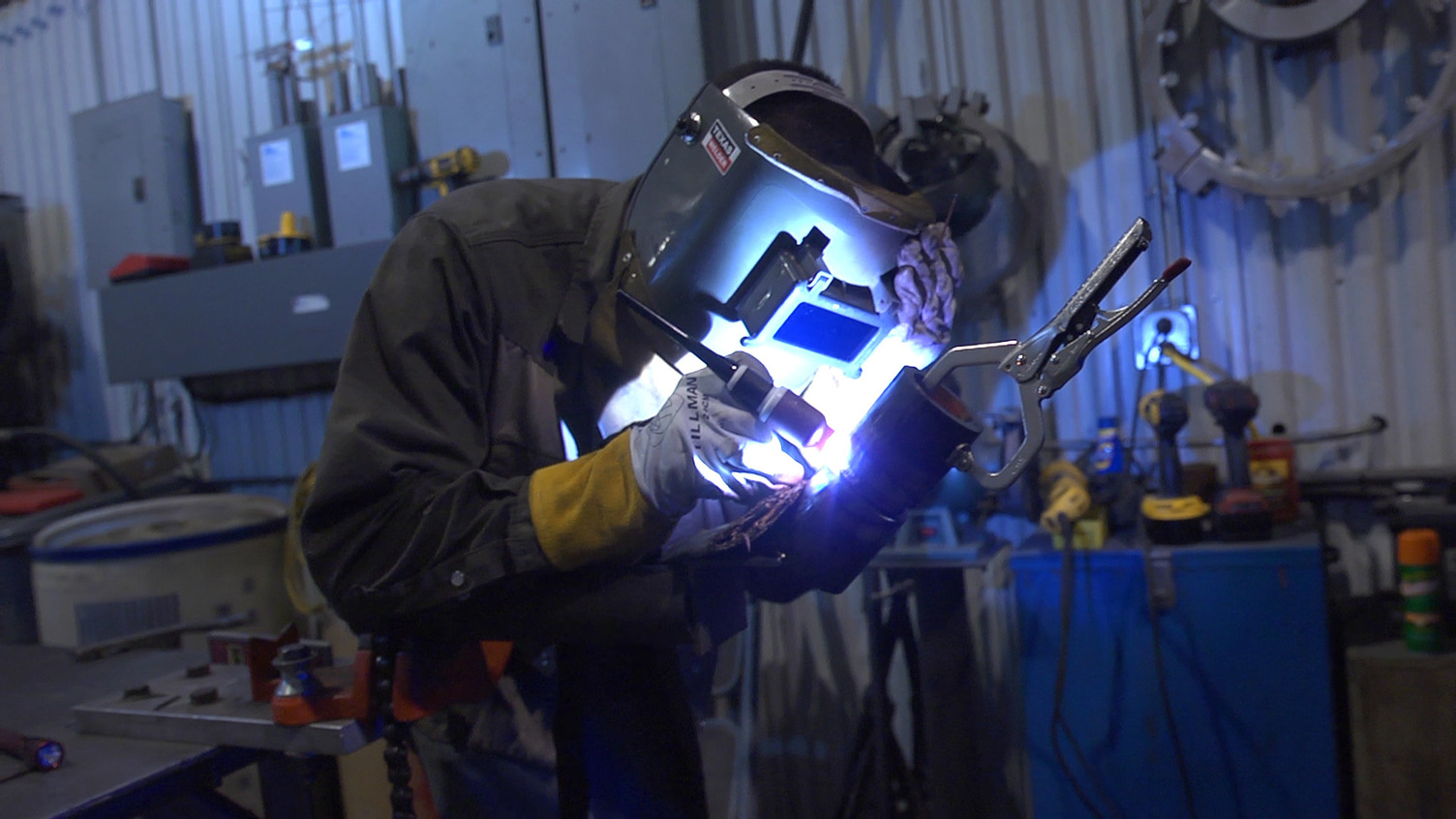
MIG is the most accessible starting point. It is the most widely used process in fabrication shops and manufacturing, and the fastest route to an entry-level position for someone with no prior experience. Stick handles dirty or rusty steel without a shielding gas setup, which is why it dominates outdoor structural and pipeline work across the Gulf Coast.
TIG produces the highest-quality welds and is used on stainless steel, aluminum, and pressure vessels. It is demanding to learn and rarely the right first process, but once a welder has MIG or Stick fundamentals in place, TIG opens up the higher-specification industrial work.
Pipe welders and combo welders certified in both SMAW and GTAW are consistently in demand on the Gulf Coast. Many roles require qualification in more than one process before a welder can work unsupervised on critical systems.
The TWS Professional Welder program covers SMAW, MIG, TIG, and flux-cored welding within the seven-month program, so students build the full process range before they graduate.
That matters because process gaps show up at hire. A welder who only trained on MIG will pass a fabrication shop test but may not qualify for a pipeline contractor posting that requires a Stick certification. Knowing all three gives you more options, and on the Gulf Coast, more options mean access to a wider range of employers and job types.
What Getting Started at TWS Houston Actually Looks Like
No prior welding experience is required to enroll. The first weeks cover safety protocols, equipment setup, and foundational arc control. From there, the work gets progressively more technical.
The admissions requirement is a high school diploma or GED. Students who do not yet have a diploma can earn that credential alongside enrollment. The program runs for as few as seven months.
Class options include morning, afternoon, evening, and weekend schedules, which matters for anyone still working or managing other commitments while they train.
The Houston campus curriculum covers the full process range Gulf Coast employers hire for:
- SMAW, TIG, MIG, and flux-cored welding
- Structural and pipe welds in positions from 2F through 6G
- Plasma cutting, carbon arc gouging, and torch work
- Combination welding and bend test preparation
Students start on flat position welds and progress through vertical, overhead, and pipe positions as their skills develop. By the time a student reaches pipe positions, they are working in the same configurations that show up on Gulf Coast job site weld tests. Each position requires the muscle memory and arc control built in the one before it.
Because Tulsa Welding School (TWS) Houston is an AWS ATF, students can earn their CW credential on campus before the program ends. Career Services support is available after graduation. Financial aid options include federal financial aid, over $7 million in available scholarships, and GI Bill eligibility for qualifying veterans. Upcoming start dates are June 1, 2026, and July 6, 2026.
Start Training for Gulf Coast Welding Work
The shortage of qualified welders on the Gulf Coast is real, and the path from no experience to job-ready is shorter than most people expect. TWS Houston’s seven-month program covers the processes Gulf Coast employers hire for, with on-campus AWS certification testing and schedule options built around real life.
Request more information or schedule a tour at the Houston campus.