Key Takeaways
- Electrical training starts with schematics, meter readings, and control and high-voltage wiring, which is new ground for students without wiring experience.
- The refrigeration cycle is hard to picture because students can’t see refrigerant change state, so they learn to read it through pressure and temperature.
- EPA 608 Type II, Type III, and Universal tests are closed-book and proctored, and each 25-question section requires a 70% to pass.
- A course order that teaches fundamentals first, along with repeated lab practice, helps students work through all three subjects.
TWS is a Great Training Option for Everyone
Learn more about how we can prepare you to advance your career.
The hardest parts of HVAC school are usually electrical troubleshooting, the refrigeration cycle, and the Environmental Protection Agency (EPA) Section 608 certification exam. Electrical work is often the biggest adjustment for students with no wiring background. Each subject builds on the one before it, and hands-on labs give students multiple chances to apply what they’ve learned.
Students don’t learn each subject once and move on.
At TWS, the fundamentals students learn in their first few courses come back in residential, commercial, and troubleshooting courses throughout the Refrigeration Technologies program. Each course puts the same concepts to work on more complex systems, so reading schematics, taking meter readings, and tracing the refrigeration cycle grow more familiar as students’ knowledge deepens.
Is the Electrical Part of HVAC Training Hard for Beginners?
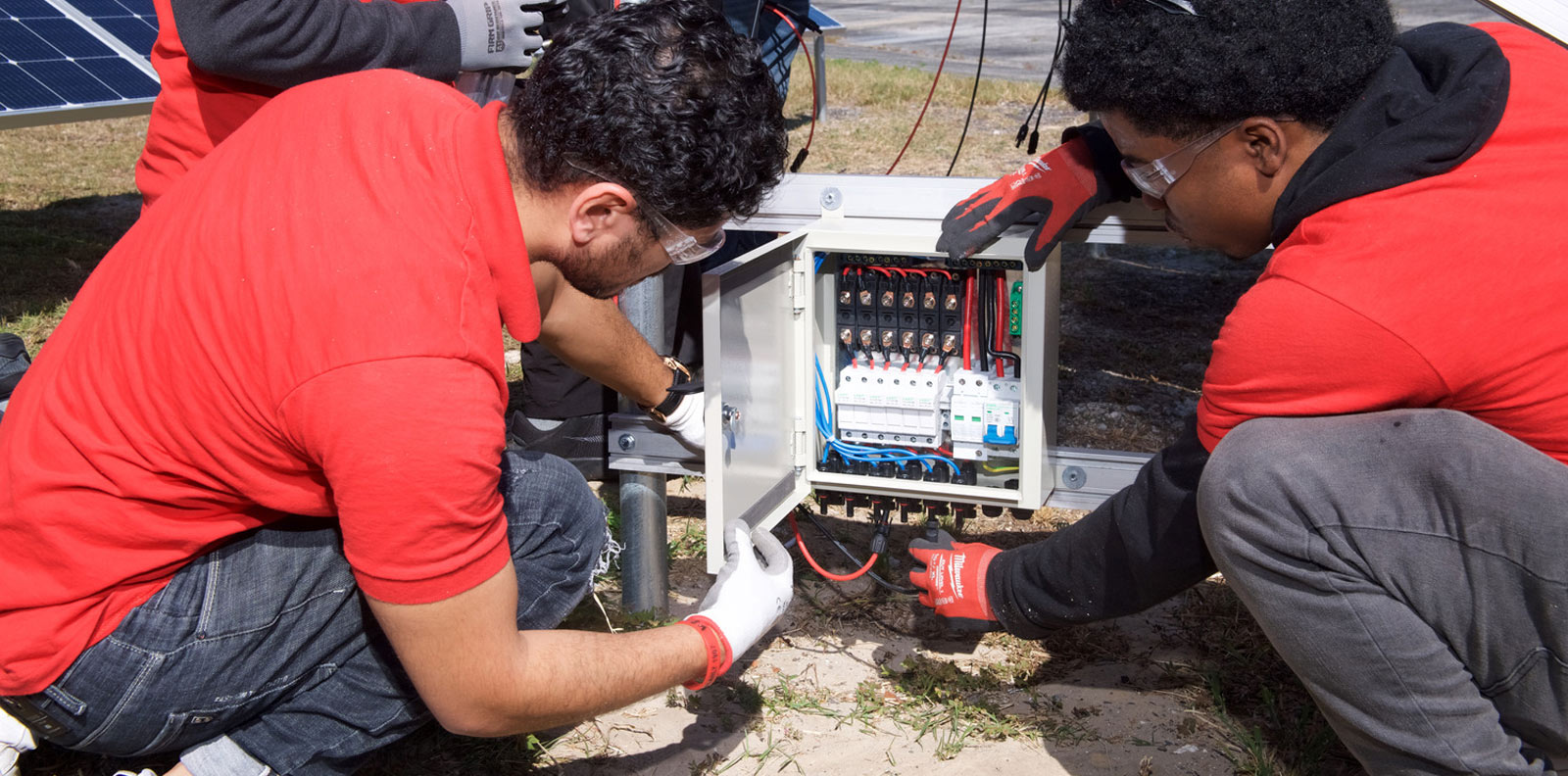
The electrical part of HVAC training can be hard for beginners because the first course asks students to read schematics, use a meter, and work with control and high-voltage wiring. At TWS, HVE100 Fundamentals of Electricity covers schematic wiring, meter use, electrical safety, dual-voltage systems, and control and high-voltage wiring.
Have You Considered a Career in the Skilled Trades?
Fill out the form to recieve a no obligation info packet.
Modern HVAC systems rely on electrical components to operate, so electrical skills come up throughout the job. HVAC technicians install electrical components and wiring. They also test electrical circuits or components for continuity using electrical test equipment.
Safety raises the stakes. Workers around electricity face electric shock, electrocution, fires, and explosions. Lockout/tagout procedures keep equipment shut off and locked while it’s serviced. They protect workers because the unexpected release of stored energy can cause serious injury or death.
How Students Work Through Electrical Troubleshooting
Students build electrical skills in layers, starting simple and adding complexity:
- Fundamentals first. TWS requires HVE100 Fundamentals of Electricity and HVR100 Fundamentals of Refrigeration before HVR110 Comfort Systems, Residential.
- Hands-on wiring. With a learning kit, TWS students can wire, troubleshoot, and assemble a system that mirrors real equipment.
- Advanced troubleshooting. HVR200 Advanced Troubleshooting Techniques uses the E-STAR Trainer for electrical and mechanical troubleshooting.
Why Is the Refrigeration Cycle Hard to Learn?
The refrigeration cycle is hard to learn because students can’t see the refrigerant change state. They have to read it through pressure and temperature as the refrigerant evaporates at low pressure and condenses at high pressure.
A compressor moves refrigerant between the evaporator and condenser. The refrigerant absorbs unwanted heat inside a home and transfers it to the air outside. A heat pump runs the same cycle in reverse in winter, which adds a second direction to learn.
Basic HVAC classes typically break the cycle into four stages, each tied to one component:
| Stage | Component | What the refrigerant does |
|---|---|---|
| Compression | Compressor | Gets compressed into a high-pressure, high-temperature vapor |
| Condensation | Condenser (outdoor coil) | Releases heat outside and condenses to a liquid |
| Expansion | Expansion device | Drops in pressure before entering the evaporator |
| Evaporation | Evaporator (indoor coil) | Absorbs heat from indoor air and evaporates to a gas |
How Students Work Through the Refrigeration Cycle
Lab gauges turn the invisible cycle into readings students can watch. At TWS, HVR100 Fundamentals of Refrigeration teaches the mechanical and physical properties of the refrigeration cycle, along with manifold gauges, vacuum pumps, and charging and recovery equipment. Gauges connect each stage to real pressure readings, so students can trace one loop of refrigerant through all four stages and tie each component to its job.
The cycle also ties back to electrical work. Technicians must identify problems with malfunctioning systems, which often means connecting an electrical symptom to what’s happening in the cycle.
How Hard Is the EPA 608 Exam for HVAC Students?
The EPA 608 exam takes focused study, because Type II, Type III, and Universal certification require a closed-book, proctored test. Each section takes 70% to pass. Technicians who maintain, service, repair, or dispose of equipment that could release refrigerants must be certified. Only certified technicians, or employers of certified technicians, can buy refrigerant.
The exam is built in sections. Each Type I, II, or III test has 25 core questions and 25 type-specific questions, and the Universal test has 100 questions. The core section covers the environmental effects of refrigerants, laws and regulations, and the industry outlook. The type sections cover leak detection, recovery, safety, shipping, and disposal.
Each certification type covers a different class of equipment:
| Certification type | Equipment covered |
|---|---|
| Type I | Small appliances |
| Type II | High- or very-high-pressure appliances, except small appliances and motor vehicle air conditioners |
| Type III | Low-pressure appliances |
| Universal | All types of equipment |
Type I is the only test that can be taken by mail or open book. A mail-in Type I test requires an 84% score, and an open-book core test can’t count toward Universal certification. Section 608 certification credentials don’t expire.
EPA requires nearly all HVAC technicians to be certified, and postsecondary programs typically prepare students for the exam. At TWS, students who pass the R-410A test in HVR120 receive an R-410A safety certification and EPA Section 609 certification. In HVR200, students have the opportunity to qualify for EPA Section 608 certification.
Students take the 608 exam through an EPA-approved certifying organization, not through the school or the EPA itself. Section 608 rules also apply to handling newer A2L refrigerants.
How Students Prepare for the EPA 608 Exam
The exam’s structure points to a study plan:
- Study one section at a time. Each type is its own 25-question section.
- Memorize rules for the core. The core section covers regulations and environmental facts rather than hands-on skills.
- Aim for at least 18 correct answers. A 70% score on a 25-question section works out to 17.5, so 18 is the minimum.
- Practice without notes. Candidates take the exam under a chief examiner, with no notes or training materials allowed.
What Helps HVAC Students Get Through the Hard Parts?
Students get through the hardest parts of HVAC school with a course order that teaches electrical and refrigeration fundamentals first, then repeats them in residential, commercial, and troubleshooting courses. At TWS, each course is worth 100 contact hours.
TWS’s Refrigeration Technologies program includes seven courses:
- HVE100 Fundamentals of Electricity
- HVR100 Fundamentals of Refrigeration
- HVE110 Fundamentals of Solar
- HVR110 Comfort Systems, Residential
- HVR120 Comfort Systems, Commercial
- HVR130 Refrigeration Systems & Practices
- HVR200 Advanced Troubleshooting Techniques
A seven-month program also offers a class schedule the student can keep. TWS offers morning, afternoon, and evening classes, along with a flexible HVAC training hybrid model with theory online and labs on campus. Students who want more electrical depth can take Electro-Mechanical Technologies, a 10-month program that adds residential and commercial electrical wiring courses.
Math is part of the work, too. HVAC technicians use math skills to calculate the correct load requirements, so math shows up in both the classroom and the field.
Learning continues after graduation. North American Technician Excellence (NATE) offers a Ready-to-Work certificate designed for technicians just entering the field.
See the HVAC/R Labs in Person
Electrical troubleshooting, the refrigeration cycle, and the EPA 608 exam all get easier with the right course order and enough lab time. Seeing the labs where students practice helps you judge whether an HVAC program will prepare you.
Schedule a campus tour and see the HVAC/R labs in person, or request more information about Refrigeration Technologies.