TWS is a Great Training Option for Everyone
Learn more about how we can prepare you to advance your career.
Linework doesn’t ease everyone in. Many utility employers extend a conditional offer and then require new hires to pass a post-offer physical assessment before the offer converts. Fail the assessment, and the offer is withdrawn. That requirement exists because the job is physically specific in ways that can’t be trained around.
The same body that struggles with a 75 lb lift in a harnessed position is the one making judgment calls near energized lines.
Physical fitness and safety awareness aren’t separate requirements in linework. They’re the same requirement with two names. Employers expect both because a fatigued or undertrained worker creates risk for themselves and the crew around them.
Understanding what the job demands physically, and what you’re expected to know about staying safe before you ever climb a pole, is how you decide whether linework is right for you, and how you show up ready if it is.
Have You Considered a Career in the Skilled Trades?
Fill out the form to recieve a no obligation info packet.
Why Linework Requires Strong Safety Training
Linework is physically demanding, safety-focused work. Because crews operate around high-voltage systems, elevated work areas, and changing weather conditions, employers place a strong emphasis on proper procedures and hazard awareness.
Industry safety data shows that the most common causes of serious incidents in linework include:
- Contact with energized lines or equipment
- Falls from poles, towers, or aerial lifts
- Transportation-related incidents while traveling between job sites
The transportation category surprises many people. Line crews often travel long distances to substations, storm response areas, and remote infrastructure locations, so driving conditions are a routine part of the job.
The good news is that modern safety standards, protective equipment, and structured training have helped reduce many workplace risks across the skilled trades. Employers expect lineworkers to follow established procedures carefully, communicate with their crews, and stay aware of their surroundings at all times.
That’s why hands-on training matters. Programs that emphasize safety practices, equipment familiarity, and real-world jobsite procedures help prepare future lineworkers for the demands of the field.
What Linework Actually Does to Your Body
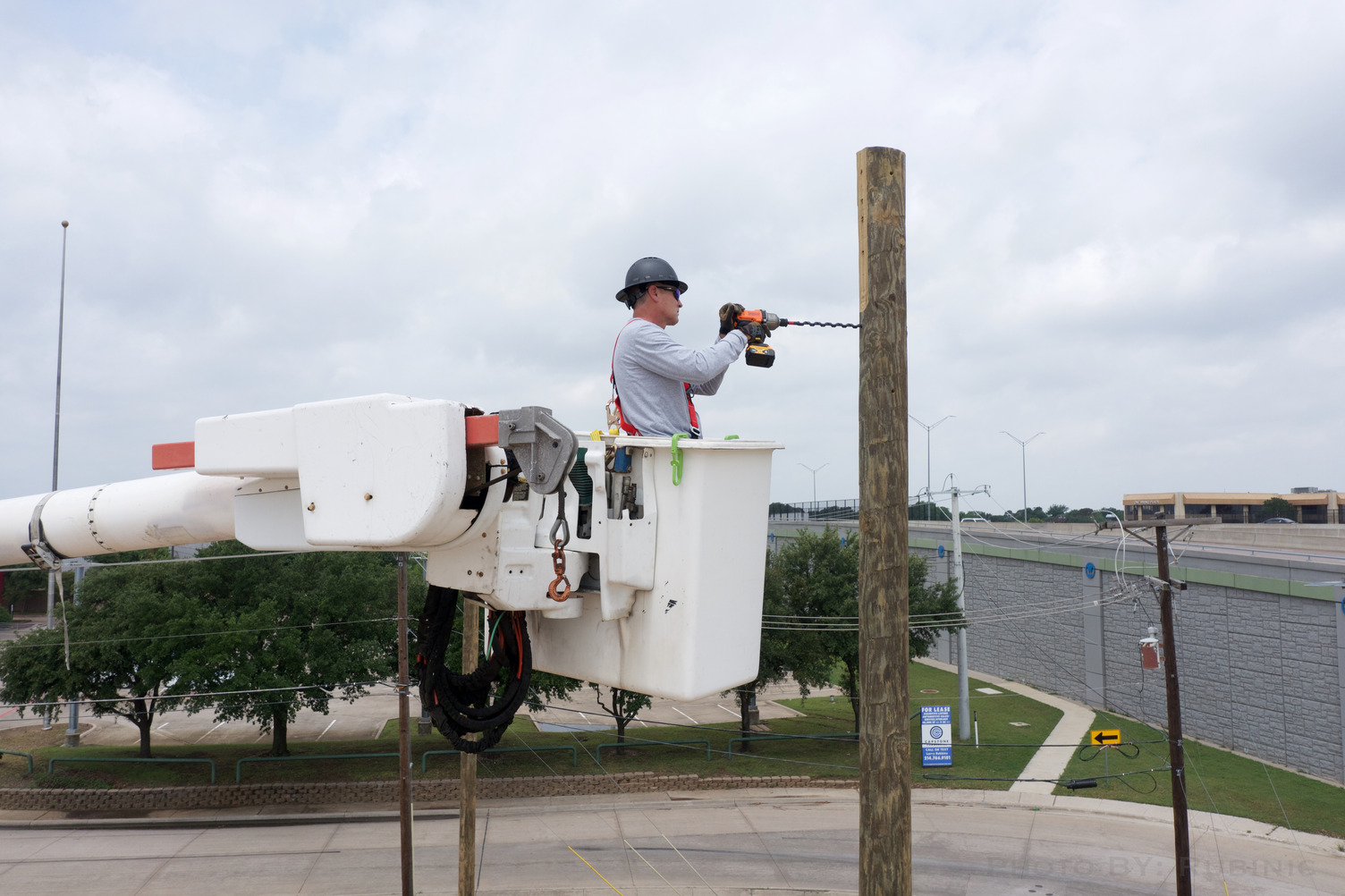
A line crew starts the day loading gear, driving to a site, and setting up before a single task begins. From there, the work involves climbing poles or operating aerial lifts, handling wire and hardware at height, running equipment like digger derricks and bucket trucks, and trenching for underground work. Storm response stretches all of that across extended hours in conditions that don’t adjust for the crew.
The physical demands aren’t background noise. Many utility employers require candidates to pass a post-offer physical assessment to verify that a person can perform the job before the conditional offer becomes permanent. Specific tasks tested include:
- Lifting a 60 lb crossarm from a holder and raising it to eye level
- Lifting a 75 lb crossarm from a harnessed position on the pole and holding it in place
- Holding a single-leg balance for 30 seconds per side without touching down, testing the static stability required when working aloft
There’s no formal height requirement to become a lineman. Strength, stamina, and coordination carry more weight than any physical measurement. Weight restrictions do apply when working aloft, with limits tied to the load capacity of climbing equipment, and specific thresholds vary by employer and program.
The Physical Traits That Matter Most
The physical assessment prep guidelines utility employers publish point directly to what the job loads most heavily.
- Grip strength runs through every task. Climbing requires continuous hand pressure, and handling wire at height demands sustained grip under tension.
- Shoulders and upper back take the load when working a hot stick laterally from a harnessed position. That task requires significant shoulder, upper back, and grip strength working simultaneously.
- Core keeps a lineman stable on a pole. Static balance at height depends on stomach, back, and leg strength working together, not independently.
- Legs absorb the repetitive load of climbing. Ascending and descending a pole across a full shift is the work, not a warm-up.
- Color vision is worth noting separately. Distinguishing color-coded wiring is a baseline requirement, and absent color vision can disqualify a candidate before the physical assessment begins.
What Shape You Need to Be in Before You Start
Physical readiness isn’t built on the job. It’s tested before the job starts. The assessment happens after a conditional offer is extended, which means preparation needs to come before the application process ends, not after.
Utility assessment prep guidelines are specific about what to train. The exercises recommended map directly to the tasks tested:
- Squats, lunges, and leg presses for the climbing demand on legs
- Planks for core and stabilizer strength used when working aloft
- Arm curls and shoulder raises for the lifting and tool work required on the pole
- Grip exercises for the continuous hand strength pole climbing demands
Cardiovascular conditioning matters alongside strength. Storm restoration work is extended and unrelenting, and a lineman who fatigues early is more likely to skip a step or miss a hazard than one who isn’t running on empty.
TWS’s 15-week Electrical Lineworker program delivers 80% of instruction as hands-on, field-based training under veteran lineworkers. It isn’t a gym program, but repeated pole climbing, equipment operation, and site work condition the body for what line work actually requires. The muscle memory built during training is what a crew sees and evaluates on day one.
A body conditioned for the work is also a body less likely to fatigue into a mistake near energized equipment. That’s where physical preparation and safety meet, and it’s why employers treat both as prerequisites rather than separate boxes to check.
What Employers Expect Before You Climb Your First Pole
Entry-level lineman job postings carry a consistent set of requirements. Most list:
- A high school diploma or GED
- Completion of an accredited lineman training program
- A valid driver’s license, with a CDL often required or strongly expected, as line crews operate heavy trucks and aerial equipment daily
- OSHA-10 certification, covering hazard recognition, fall protection, electrical safety, and emergency procedures
- CPR and first aid certification
- NCCER Power Line Worker certification, which many employers recognize as a marker of quality training
Graduates who also hold Pole Top Rescue and Bucket Rescue certifications bring credentials that signal hands-on readiness beyond the classroom. TWS graduates can earn up to 9 certifications within the 15-week program, including OSHA-10, both rescue certifications, CPR, First Aid, Climbing, Digger Derrick, and Chainsaw Safety.
The Safety Concepts Every New Lineman Learns First
Line work safety isn’t a set of common-sense guidelines. It’s a structured body of federal standards, industry protocols, and site-specific procedures that every qualified lineman is expected to know before touching a line.
OSHA 1910.269 is the federal standard governing all electric power generation, transmission, and distribution work. Under it, a “qualified employee” isn’t defined by completing a program. The designation applies to someone who can identify live parts, determine voltage levels, maintain minimum approach distances (MAD), and select the correct PPE for the task at hand.
The concepts new linemen train on first include:
- Minimum Approach Distance (MAD). The legally required physical distance from energized lines, calibrated to the voltage present. Breaching that boundary without authorization is a safety violation, not a procedural technicality.
- Lockout/Tagout (LOTO). The procedure for isolating an energy source before any maintenance begins, ensuring a line cannot be re-energized while someone is working on it.
- Tailboard Briefing. Before every job, the crew reviews hazards, work procedures, energy source controls, and PPE requirements together. A single lapse on a crew doesn’t stay with one person. The briefing is where shared accountability gets established.
- Induction Hazards. Grounded systems aren’t automatically safe. A conductor near an energized line can carry induced current without direct contact. Assuming a grounded system is safe without verifying it is one of the ways linemen get hurt on otherwise routine tasks.
- Cover-Up Equipment. Protective material staged around the work area to keep workers separated from energized parts and to prevent conductors from contacting the grounded surface of a pole. Cover-up must be fully in place before work begins. Moving it mid-job to accommodate a task is one of the conditions most associated with elevated electrocution risk.
PPE and What Each Piece Protects Against
Personal protective equipment in line work is matched to specific hazards, and every piece requires inspection before it goes on. A glove that doesn’t seal or a harness that doesn’t fit correctly creates exposure rather than protection.
Ill-fitting PPE doesn’t protect as designed regardless of its rating.
| PPE Item | What It Protects Against |
|---|---|
| Hard hat with face shield | Falling debris and arc flash exposure |
| Flame-resistant (FR) clothing | Arc flash heat and burn injuries |
| Rubber insulating gloves with leather protectors | Electric shock; required inspection before every shift |
| Composite-toe insulated boots | Current flow through the body, impact hazards, and unstable footing |
| Harness and fall protection | Falls from poles, towers, and aerial lifts; daily inspection required |
Getting sized correctly and building the habit of inspecting gear before each shift both start in training. Those habits carry onto every job site after.
Rescue Training and Why New Linemen Practice It First
Most people considering a lineman career have never heard of Pole Top Rescue or Bucket Rescue. Both are standard certifications, and both are practiced before a graduate steps onto a job site.
Pole Top Rescue covers the procedure for retrieving a worker who has become incapacitated at the top of a pole, performed by another lineman climbing up to them. Bucket Rescue applies when a worker in an aerial lift is incapacitated or the lift fails and the operator can’t bring it down independently.
OSHA requires every worksite to have a rescue plan, and rescue training is a direct part of meeting that obligation.
Linemen don’t just train to protect themselves from the hazards of the trade. They train to get each other home. Both certifications are completed in the field as part of the TWS Electrical Lineworker program before graduation.
Start Your Lineworker Training at TWS
If linework fits what you’re looking for in a trade, the next step is finding a program that prepares you for the physical and safety realities of the job, not just the credential checklist.
Request more information to connect with an admissions representative, or schedule a tour to see the program firsthand.